
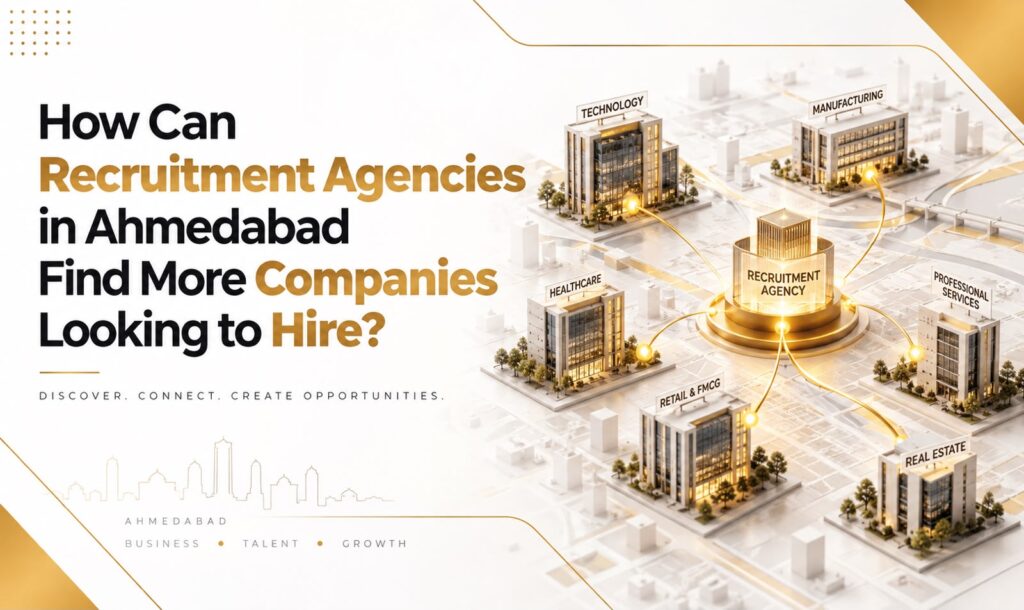
Social Media Marketing for Recruitment Agencies In Ahmedabad can help recruitment agencies reach qualified candidates while also connecting with companies that are actively looking to hire.
A recruitment agency can have a large candidate database, experienced recruiters, and strong industry knowledge, but these resources generate business only when companies with genuine hiring requirements can discover, evaluate, and contact the agency. Partnering with a Digital Marketing Agency in Ahmedabad can help recruitment agencies strengthen their online visibility, reach businesses actively looking for recruitment solutions, build credibility, and generate more qualified business enquiries.
This is where digital marketing becomes important.
Today, a company hiring for an accountant, software developer, production manager, sales executive, HR professional, engineer, pharmaceutical specialist or senior management position may begin its search online. Instead of immediately calling a recruitment consultant, the employer may search Google for:
* Recruitment agency in Ahmedabad
* Recruitment consultants Ahmedabad
* Staffing agency Ahmedabad
* Recruitment agency for manufacturing companies
* IT recruitment agency Ahmedabad
* Executive search firm Ahmedabad
* Recruitment agency for SMEs
* Manpower consultancy Ahmedabad
* Recruitment services for companies
* Hiring agency for urgent recruitment
* Contract staffing Ahmedabad
* RPO services Ahmedabad
The agency that appears at the right stage and clearly communicates its expertise has an opportunity to become part of the employer’s hiring process.
Current Ahmedabad recruitment websites demonstrate that the market already competes heavily around industry specialization, employer-focused hiring solutions, candidate screening, permanent recruitment, contract staffing, executive search and RPO. (Achievers Enterprise)
That means simply publishing a page titled “Recruitment Agency in Ahmedabad” is unlikely to communicate enough differentiation.
A stronger strategy is to answer the employer’s actual questions:
Can this agency recruit for my industry?
Do they understand the type of role I need?
How do they screen candidates?
Can they handle urgent or multiple vacancies?
What happens after I submit a hiring requirement?
Will the agency understand our company and hiring expectations?
Can I trust the profiles they send?
The goal of recruitment-agency marketing should therefore be:
Google Search → Employer discovers agency → Industry/service page → Trust and expertise → Hiring requirement → Consultation → Candidate shortlist → Placement → Repeat hiring
This article explains how recruitment agencies in Ahmedabad can build that employer-acquisition system using SEO, employer-focused content, industry targeting, website optimization, local search, lead generation, employer branding and long-term relationship marketing.

What Do Companies Check Before Choosing a Recruitment Agency?
Companies generally evaluate a recruitment agency based on whether it appears capable of solving their particular hiring problem—not simply whether it calls itself a “top recruitment agency.”
Before contacting an agency, an employer may want to understand its industry experience, recruitment model, candidate sourcing process, role specialization, screening approach, communication process and ability to handle the type of hiring requirement involved.
This means the agency website needs to answer employer questions before asking the employer to submit an enquiry.
A company hiring five software developers has different requirements from a manufacturing company hiring a plant manager. Similarly, a pharmaceutical company looking for experienced sales professionals may evaluate a recruitment partner differently from an SME hiring administrative staff.
An employer may check:
* Which industries does the agency serve?
* Which job functions does it recruit for?
* Does it handle permanent hiring?
* Does it provide contract staffing?
* Does it support executive recruitment?
* Does it handle bulk hiring?
* Does it offer RPO?
* How does candidate screening work?
* How does the agency understand job requirements?
* How does the agency communicate candidate profiles?
* Does it provide replacement terms?
* Does it work locally or across India?
* How can the company submit a hiring requirement?
Current recruitment agencies in Ahmedabad commonly emphasize sector specialization and employer-focused services. For example, Achievers Enterprise provides dedicated employer hiring functionality and highlights sectors such as IT, manufacturing, pharma, finance, engineering, and e-commerce. With the support of SEO Services in Ahmedabad, recruitment agencies can improve their visibility for relevant industry-specific searches, helping potential employers discover their services when looking for reliable recruitment solutions.
This creates an important SEO opportunity.
Instead of having one generic services page, a recruitment agency can create useful pages around actual employer needs:
IT Recruitment Services
Manufacturing Recruitment
Pharma Recruitment
Executive Search
Contract Staffing
Bulk Recruitment
RPO Services
Each page should explain what the service means, who it is suitable for, what roles the agency supports and how an employer can start the process.
Trust also matters.
An employer is potentially giving the agency confidential information about open positions, salary ranges, organizational structure and hiring requirements. The website should therefore communicate professionalism and clarity.
The strongest employer-facing website answers the question:
“Why should I trust this recruitment agency with my hiring requirement?”
The answer should come from evidence the agency genuinely possesses—such as actual industry specialization, transparent processes, genuine client relationships, recruiter expertise and verified case studies—not invented claims or unsupported numbers.
How Can Recruitment Agencies Target Companies Based on Industry and Hiring Needs?
Recruitment agencies can attract more employer enquiries by moving from broad “recruitment agency” targeting toward industry-specific and hiring-need-specific positioning.
This matters because companies rarely think about recruitment in generic terms.
An Ahmedabad manufacturer may search for a recruitment partner because it needs production engineers, quality professionals, plant managers or shop-floor workers.
An IT company may need software developers, QA engineers, project managers or technical leads.
A pharmaceutical company may need production, quality assurance, regulatory, sales or research professionals.
A logistics company may need warehouse staff, operations managers, supply-chain professionals or fleet-related roles.
The agency therefore needs to connect:
Industry → Hiring Problem → Role → Recruitment Solution
Ahmedabad’s current recruitment SERP already reflects strong industry segmentation. Recruitment businesses prominently mention IT, manufacturing, engineering, pharma, healthcare, finance, logistics, sales and other verticals.
A recruitment agency can turn this into a structured SEO architecture.
For example:
Industry pages
* IT Recruitment Agency in Ahmedabad
* Manufacturing Recruitment Agency in Ahmedabad
* Pharma Recruitment Agency in Ahmedabad
* Engineering Recruitment Agency in Ahmedabad
* Healthcare Recruitment Agency in Ahmedabad
* Finance Recruitment Agency in Ahmedabad
* Logistics Recruitment Agency in Ahmedabad
Hiring-solution pages
* Permanent Recruitment
* Contract Staffing
* Executive Search
* Bulk Hiring
* Urgent Recruitment
* RPO Services
* Specialist Recruitment
Role-focused content
* Software Developer Recruitment
* Sales Recruitment
* Finance Recruitment
* HR Recruitment
* Production Engineer Recruitment
* Quality Control Recruitment
The purpose is not to create hundreds of thin pages simply to capture keywords.
Each page should have a genuine reason to exist.
An industry page should explain:
* Common hiring requirements
* Relevant roles
* Candidate profiles
* Recruitment challenges
* Screening considerations
* Recruitment process
* How the agency supports employers
A hiring-solution page should explain:
* When the solution is appropriate
* What the agency manages
* What the employer provides
* How the process works
* What the employer can expect
* How to submit a requirement
This creates a much stronger employer acquisition funnel.
For example:
“Manufacturing recruitment agency Ahmedabad”
→ Manufacturing recruitment page
→ Roles supported
→ Screening process
→ Relevant proof
→ Employer enquiry
Whereas:
“Recruitment agency Ahmedabad”
→ Generic homepage
may leave the employer wondering whether the agency actually understands their sector.
Industry targeting therefore helps SEO, but more importantly, it helps the right employer recognize relevance immediately.

Why Do Some Recruitment Enquiries Fail to Become Business Clients?
Generating an employer enquiry does not automatically mean generating a recruitment client.
A company may submit a form and never respond again. A business may ask for pricing but not proceed. An HR manager may contact several agencies simultaneously. Another employer may decide that the agency does not specialize in its hiring requirements.
The problem can therefore occur at multiple points between first contact and commercial engagement.
One common issue is a mismatch between the agency’s marketing promise and the employer’s actual requirement.
For example, an agency may promote itself as a general recruitment company but have limited experience in a highly specialized technical sector. If the website does not communicate its actual capabilities clearly, the wrong leads may arrive.
Another problem is insufficient information.
An employer may want to know:
* What industries does the agency specialize in?
* What positions can it recruit?
* What geographic areas does it cover?
* Does it support permanent or contract hiring?
* How quickly does the recruitment process begin?
* How are candidates screened?
* What information is required from the employer?
* How does the commercial model work?
If the website does not answer these questions, the employer may move to another agency.
A third problem is poor lead qualification.
A generic form such as:
Name + Phone + Message
does not give a recruitment agency much context.
An employer-focused form can instead request:
* Company name
* Contact person
* Business email
* Industry
* Job title
* Number of vacancies
* Hiring location
* Experience required
* Key skills
* Hiring urgency
* Job description upload
An existing Ahmedabad recruitment site demonstrates this employer-focused approach by collecting job title, vacancies, location, qualification, experience, salary/CTC, industry, urgency, skills and job description. (Achievers Enterprise)
The form should still avoid becoming unnecessarily complicated.
Another reason enquiries fail is slow or unclear follow-up.
If a company submits a hiring requirement but receives no clear acknowledgement, the business may contact another recruitment provider.
The solution is to build a process:
Employer enquiry → Requirement review → Qualification → Recruiter assignment → Requirement discussion → Candidate sourcing → Shortlist → Interview coordination → Offer → Joining
Marketing should support this process rather than operate independently.
Recruitment agencies should also distinguish between lead volume and lead quality.
Twenty irrelevant employer enquiries may be less valuable than a few enquiries from companies with genuine hiring requirements.
Therefore, the website should optimize for relevant employer intent, not simply maximum form submissions.
How Can a Recruitment Agency Website Turn Visitors Into Employer Enquiries?
A recruitment agency website should be designed as an employer acquisition platform rather than only an online profile.
Many recruitment websites give equal visual prominence to “Find Jobs” and “Hire Talent.” This is understandable because recruitment agencies serve two audiences, but it can create confusion when the primary objective is to acquire employer clients.
The first step is to clearly separate the two journeys:
For Employers → Hire Talent
For Candidates → Find Jobs
Current Ahmedabad recruitment websites commonly provide separate employer and candidate journeys. Achievers Enterprise, for example, has dedicated employer hiring functionality, while other agencies prominently separate “Hire Talent” and “Find Jobs.”
An employer landing page should immediately communicate:
Who the agency helps + what it recruits + how the process works + how to start hiring.
A strong employer page can contain:
Employer-focused headline
Example:
Recruit Qualified Talent for Your Growing Team
Supporting explanation
Explain the industries, functions and hiring models supported.
Recruitment solutions
* Permanent recruitment
* Contract staffing
* Executive search
* Bulk hiring
* RPO
* Specialist recruitment
Industries
Show the sectors the agency genuinely serves.
Recruitment process
Explain:
Requirement → Sourcing → Screening → Shortlisting → Interviews → Selection → Joining
Trust elements
Use only genuine evidence:
* Verified testimonials
* Actual client logos with permission
* Real case studies
* Recruiter expertise
* Industry experience
* Transparent process
* Genuine placement information
Employer CTA
Examples:
Submit Your Hiring Requirement
Talk to a Recruitment Consultant
Request Recruitment Support
The enquiry form should be designed around employer needs rather than candidate needs.
A useful employer form might request:
* Company
* Contact person
* Business email
* Phone
* Hiring requirement
* Industry
* Number of vacancies
* Location
* Experience level
* Job description
The website should also create relevant entry points from Google.
For example:
Google Search → Manufacturing Recruitment Page → Employer CTA
Google Search → IT Recruitment Page → Employer CTA
Google Search → Executive Search Ahmedabad → Consultation CTA
This is more effective than sending every visitor to the homepage.
The website should also answer objections.
For example:
“How does your recruitment process work?”
“How are candidates screened?”
“What hiring requirements can you support?”
“Do you handle urgent recruitment?”
“Do you recruit for permanent and contract roles?”
When these questions are answered before the enquiry, the employer can make a more informed decision.
The website’s goal is not simply to produce a form submission.
It is to help the right company feel confident enough to start a hiring conversation.

Which Industries in Ahmedabad Commonly Need External Recruitment Support?
Ahmedabad has a diverse business ecosystem, so recruitment demand can arise from multiple industries rather than one dominant sector.
Current recruitment providers serving Ahmedabad commonly identify industries such as IT and technology, manufacturing, engineering, pharma and healthcare, finance, construction, FMCG, e-commerce, logistics, sales and other corporate functions. (Achievers Enterprise)
However, a recruitment agency should avoid saying that every company in these sectors necessarily uses external recruitment agencies.
The more useful question is:
Which types of hiring problems can external recruitment support help solve?
Manufacturing and Engineering
Manufacturing companies may need recruitment support for:
* Production
* Quality
* Maintenance
* Engineering
* Plant operations
* Procurement
* Supply chain
* Supervisory positions
* Management roles
IT and Technology
Technology businesses may require:
* Developers
* QA professionals
* Cloud specialists
* Data professionals
* Project managers
* Technical leads
* Cybersecurity professionals
* Product roles
Pharma and Healthcare
Recruitment requirements can include:
* Production
* Quality
* Regulatory
* Sales
* Healthcare professionals
* Operations
* Administration
Finance and Accounting
Companies may require:
* Accountants
* Finance executives
* Controllers
* Tax professionals
* Audit professionals
* Senior finance managers
Sales and Marketing
Businesses across sectors may need:
* Sales executives
* Business development professionals
* Area managers
* Marketing specialists
* Digital marketing professionals
* Sales leadership
Logistics and Supply Chain
Possible hiring areas include:
* Warehouse
* Procurement
* Supply chain
* Logistics operations
* Planning
* Inventory
* Distribution
Startups and SMEs
Smaller businesses may seek external recruitment support when they do not have a large internal recruitment team or when they need specialized hiring assistance.
The SEO opportunity is to create content around industry + recruitment problem, not merely industry names.
For example:
“How Can Manufacturing Companies in Ahmedabad Find Skilled Production Engineers?”
is more useful than:
“Manufacturing Recruitment Ahmedabad.”
The first identifies the employer’s actual problem.
Similarly:
“How Can Ahmedabad IT Companies Hire Specialized Developers?”
connects industry, role and hiring challenge.
This approach can produce content that attracts companies at the exact moment they realize they need recruitment support.
It also allows the recruitment agency to demonstrate domain understanding rather than simply claiming to serve “all industries.”
The important principle is credibility.
If an agency genuinely specializes in manufacturing, it should explain manufacturing hiring.
If it primarily works in IT, it should demonstrate IT recruitment knowledge.
Specialization can become both a content strategy and a positioning strategy.
Why Should Recruitment Agencies Create Separate Content for Employers and Job Seekers?
Yes. Recruitment agencies should generally create separate content pathways for employers and job seekers because the two audiences have fundamentally different search intents, questions and conversion actions.
A job seeker may search:
* Jobs in Ahmedabad
* IT jobs Ahmedabad
* HR jobs Ahmedabad
* Jobs for freshers
* Latest vacancies
* Resume tips
* Interview questions
* Career advice
An employer may search:
* Recruitment agency Ahmedabad
* Staffing agency Ahmedabad
* IT recruitment agency
* Recruitment consultants for manufacturing
* Executive search Ahmedabad
* Hiring agency
* Contract staffing Ahmedabad
* Recruitment outsourcing
These are not simply different keywords.
They represent different users with different goals.
The candidate wants an opportunity.
The employer wants a hiring solution.
The candidate’s desired action may be:
Search Jobs → View Job → Apply → Upload CV
The employer’s desired action may be:
Search Recruitment Agency → Evaluate Expertise → Submit Requirement → Speak to Recruiter
If both journeys are mixed together, the website can become difficult to navigate.
A better structure is:
Employer navigation
Hire Talent
* Recruitment Services
* Permanent Hiring
* Contract Staffing
* Executive Search
* RPO
* Industries
* Employer Enquiry
Candidate navigation
Find Jobs
* Search Jobs
* Upload CV
* Career Advice
* Interview Tips
* Job Alerts
This separation can also improve SEO architecture because each content cluster has a clear intent.
Employer content should answer:
How can the agency help my company hire?
Candidate content should answer:
How can the agency help me find a job?
Current Ahmedabad recruitment websites commonly operate both sides of this marketplace, but the better examples visibly separate employer and candidate actions. For example, Achievers Enterprise has separate “For Employers” and job-related pathways, while Glisten Talent Hub distinguishes recruitment services from candidate opportunities.
This does not mean the two audiences should never interact.
A recruitment business naturally connects employers and candidates.
But their digital experiences should remain clearly organized.
Employer pages can contain links to relevant recruitment services.
Candidate pages can contain job listings and CV submission.
Blog content can also be separated into categories:
For Employers
* Hiring strategies
* Recruitment trends
* Interview processes
* Workforce planning
* Talent acquisition
For Candidates
* Resume guidance
* Interview preparation
* Career development
* Job search advice
This improves usability and prevents a common problem where an employer lands on a recruitment website and sees dozens of candidate-oriented pages before finding the actual business enquiry option.
What Makes an Employer Return to the Same Recruitment Agency for Future Hiring?
The first successful placement can create an opportunity for a long-term employer relationship.
A company that repeatedly hires through the same recruitment agency is likely to value more than simply receiving resumes.
The recruitment partner needs to make the overall hiring process useful and dependable.
Several factors can contribute to repeat engagement.
Understanding the employer’s requirements
A recruiter who understands the company’s role requirements, culture, technical expectations and seniority level can potentially provide more relevant candidate searches.
Candidate relevance
Employers generally do not want large volumes of irrelevant CVs.
A smaller shortlist of appropriately screened candidates may be more useful than a large number of weak profiles.
Communication
Employers need clear updates.
For example:
Requirement received
→ Search underway
→ Candidate pipeline update
→ Profiles submitted
→ Interview status
→ Offer stage
→ Joining
Understanding urgency
A company hiring for a critical position may need a different recruitment process from an organization building a talent pipeline over several months.
Transparency
The agency should communicate clearly about:
* Candidate availability
* Hiring challenges
* Expected process
* Recruitment terms
* Replacement policies, where applicable
* Search progress
Post-placement support
The relationship should not necessarily end when the candidate joins.
The agency can maintain appropriate communication according to its actual service model.
Industry knowledge
An employer may prefer an agency that understands its sector.
For example, a manufacturing company may value a recruiter who understands engineering terminology and plant-level roles.
An IT company may value recruiters who understand technical skills and role requirements.
Current Ahmedabad recruitment agencies frequently position industry expertise, screening, dedicated recruiters and recruitment support as important parts of their employer proposition.
This also creates content opportunities.
A recruitment agency can publish useful employer resources such as:
* Hiring checklists
* Interview frameworks
* Role descriptions
* Recruitment guides
* Industry hiring insights
* Salary research only when backed by reliable current data
* Candidate screening guidance
* Workforce planning content
The goal is to become useful between hiring requirements, not only when a company urgently needs candidates.
That creates a relationship rather than a one-time transaction.
From a digital marketing perspective, repeat employers also provide an important lesson:
The best employer acquisition strategy is not only about finding new companies. It is also about creating a digital and service experience that gives existing companies reasons to return when their next hiring requirement appears.
Why Is Employer Branding Important for Recruitment Agencies?
Employer branding for a recruitment agency is different from employer branding for the company that is hiring employees.
A recruitment agency needs to build trust with the companies that may outsource or partner with it for recruitment.
An employer visiting the agency’s website may be evaluating:
“Does this agency understand business hiring?”
“Will they represent our company professionally?”
“Will they send relevant candidates?”
“Can we trust their recruitment process?”
This means the agency’s brand should communicate more than:
“We provide recruitment services.”
It should communicate a credible reason for an employer to start a conversation.
Employer branding can be strengthened through:
Clear positioning
Explain what the agency specializes in.
For example:
Technology Recruitment
Manufacturing Recruitment
Executive Search
rather than simply claiming to recruit “for every industry.”
Transparent process
Show how the agency moves from requirement to candidate shortlist.
Genuine team information
Introduce recruiters or consultants where appropriate.
Real expertise
Explain actual industry experience without exaggerating credentials.
Genuine client evidence
Use real testimonials, client logos or case studies only when permission and verification exist.
Employer resources
Create useful guides that demonstrate recruitment knowledge.
Professional employer journey
The website should make it easy to:
* Submit a requirement
* Upload a job description
* Contact a consultant
* Understand recruitment services
* Find industry-specific solutions
Current Ahmedabad recruitment competitors frequently use industry expertise, service breadth, recruiter teams, employer forms and claims around candidate screening as key positioning elements. (Achievers Enterprise)
That makes credibility particularly important.
A recruitment agency should avoid creating artificial authority using unsupported claims such as:
“No. 1 recruitment agency.”
“Guaranteed hiring.”
“100% successful placements.”
unless there is a legitimate, verifiable basis and the claim is properly qualified.
Instead, demonstrate value through actual processes.
For example:
“Our recruiters first clarify the role, experience level, required skills and hiring context before sourcing candidates.”
That statement describes a process.
If it genuinely reflects the agency’s work, it can be more meaningful than a generic superlative.
Employer branding also extends beyond the website.
It can appear through:
* LinkedIn content
* Google Business Profile
* Employer testimonials
* Industry articles
* Recruitment guides
* Company case studies
* Hiring webinars
* Email communication
* Professional networking
The objective is to create consistent recognition.
When an HR manager sees the agency through Google, LinkedIn or a referral, the message should remain coherent.
The agency should be recognizable not simply because of its logo, but because of its specialization, expertise, process and employer value proposition.

How Can Recruitment Agencies in Ahmedabad Get Found When Companies Search for Hiring Services?
Recruitment agencies can improve their visibility for employer searches by building an SEO strategy around service + industry + location + hiring intent rather than relying only on the broad keyword “recruitment agency Ahmedabad.”
The first layer is the core local service.
Examples include:
* Recruitment Agency Ahmedabad
* Recruitment Consultants Ahmedabad
* Staffing Agency Ahmedabad
* HR Recruitment Services Ahmedabad
* Recruitment Services Ahmedabad
The second layer is industry intent:
* IT Recruitment Agency Ahmedabad
* Manufacturing Recruitment Agency Ahmedabad
* Pharma Recruitment Agency Ahmedabad
* Engineering Recruitment Agency Ahmedabad
* Healthcare Recruitment Agency Ahmedabad
* Finance Recruitment Agency Ahmedabad
The third layer is service intent:
* Executive Search Ahmedabad
* Contract Staffing Ahmedabad
* Permanent Recruitment Ahmedabad
* RPO Services Ahmedabad
* Bulk Hiring Services Ahmedabad
* Specialist Recruitment Ahmedabad
The fourth layer is problem-based intent:
* How to hire software developers in Ahmedabad
* How to find manufacturing staff in Ahmedabad
* Recruitment support for SMEs Ahmedabad
* How to hire senior executives in Ahmedabad
* How to reduce hiring time for growing companies
* Recruitment agency for urgent hiring
The current SERP confirms that Ahmedabad recruitment businesses are already building pages around location, industries and recruitment services. Randstad lists multiple recruitment sectors for its Ahmedabad office, while local agencies emphasize industry-specific recruitment and employer solutions. (Randstad)
The important difference is content quality and intent alignment.
A manufacturing recruitment page should not simply repeat:
“Best manufacturing recruitment agency Ahmedabad.”
It should explain:
* Manufacturing roles supported
* Typical hiring requirements
* Screening approach
* Relevant recruiter expertise
* Permanent/contract options
* Hiring process
* Employer enquiry method
The same principle applies to IT recruitment.
A useful IT recruitment page could explain:
* Technical roles supported
* Skill categories
* Screening stages
* Seniority levels
* Permanent/contract options
* Ahmedabad and wider hiring coverage
* Employer enquiry process
Local SEO should support these pages.
The agency’s Google Business Profile should contain accurate business information, while the website should clearly establish the agency’s location and services.
Google’s Search Essentials also emphasize creating useful content and making pages accessible to search engines rather than relying on manipulative SEO techniques.
The agency can then support organic search with other channels.
Publish employer-focused hiring insights and industry content.
Google Ads
Target high-intent employer searches where commercially appropriate.
Retargeting
Reconnect with eligible website visitors who previously explored recruitment services.
Nurture existing employer relationships and relevant business contacts.
Content marketing
Publish practical employer resources.
The most important principle is to avoid chasing every recruitment keyword.
Instead, identify the companies the agency actually wants to work with, understand their hiring problems and build content that answers those problems.
That creates a more qualified path:
Company has hiring need → Searches Google → Finds relevant recruitment content → Evaluates agency → Submits requirement → Recruitment consultation
How Can Recruitment Agencies Build a Strong Employer Lead-Generation Funnel?
A recruitment agency needs more than website traffic to acquire employer clients.
It needs a structured funnel that moves a company from initial search to a genuine hiring conversation.
A practical funnel can be divided into five stages.
Stage 1: Discovery
The employer searches for a recruitment solution.
Examples:
Recruitment agency Ahmedabad
IT recruitment agency Ahmedabad
Manufacturing recruitment agency Ahmedabad
Executive search Ahmedabad
The objective at this stage is visibility.
Stage 2: Evaluation
The employer visits the website and asks:
* Do they recruit for my industry?
* Do they support my type of role?
* Do they understand my hiring problem?
* Do they have a professional process?
This is where industry pages and service pages become important.
Stage 3: Trust
The employer evaluates:
* Process
* Team
* Experience
* Reviews
* Case studies
* Testimonials
* Client relationships
* Screening methodology
Only genuine evidence should be used.
Stage 4: Conversion
The website should provide an obvious employer CTA.
Examples:
Submit Hiring Requirement
Talk to a Recruitment Consultant
Request Candidate Support
Discuss Your Hiring Requirement
The form should capture enough information to qualify the enquiry.
Stage 5: Sales and recruitment process
The marketing team hands the enquiry to recruitment/sales.
The agency then clarifies:
* Role
* Number of openings
* Location
* Skills
* Experience
* Salary range
* Urgency
* Hiring process
* Interview stages
The recruitment team can then determine the appropriate sourcing strategy.
This is where many recruitment websites stop thinking about SEO.
But the digital experience should continue.
If an employer submits a requirement, the confirmation should clearly explain what happens next.
For example:
“Our recruitment team will review your requirement and contact you to discuss the role, hiring timeline and candidate profile.”
Only use such wording if it reflects the agency’s actual process.
A good lead-generation system also measures the funnel.
Track:
* Organic employer traffic
* Industry page visits
* Employer form submissions
* Calls
* WhatsApp enquiries
* Qualified employer leads
* Recruitment consultations
* Active employer accounts
* Repeat hiring clients
This is more meaningful than simply reporting website sessions.
Current Ahmedabad recruitment websites demonstrate employer-specific forms and hiring calls-to-action, showing that the local market is already moving toward direct employer conversion rather than relying only on generic contact pages.
For a recruitment agency, the ultimate objective is:
Relevant company discovers agency → Understands specialization → Trusts process → Submits hiring requirement → Starts recruitment relationship
That is the funnel the SEO strategy should be designed to support.
What Recruitment Content Should Ahmedabad Agencies Publish to Attract Companies?
Recruitment agencies should create content that addresses the problems HR managers, founders, business owners and hiring managers face before they decide to contact an external recruitment partner.
Instead of publishing only candidate-focused articles, agencies can create employer-focused content clusters.
Examples include:
Hiring strategy
* How Can Ahmedabad SMEs Improve Their Hiring Process?
* When Should a Company Use an External Recruitment Agency?
* What Should Companies Prepare Before Starting a Recruitment Search?
* How Can Companies Reduce Unqualified Applications?
Industry hiring
* How Can Manufacturing Companies in Ahmedabad Find Skilled Engineers?
* How Can Ahmedabad IT Companies Hire Specialized Developers?
* Recruitment Challenges for Pharmaceutical Companies
* Hiring Challenges for Growing Startups
Role-specific hiring
* How to Hire a Production Manager
* How to Hire a Senior Software Developer
* How to Find Qualified Finance Professionals
* How to Recruit Experienced Sales Managers
Recruitment services
* Permanent Recruitment vs Contract Staffing
* When Should Companies Consider Executive Search?
* What Is RPO and When Does a Business Need It?
* How Does Bulk Recruitment Work?
Employer decision-making
* What Should Companies Check Before Choosing a Recruitment Agency?
* What Questions Should HR Ask a Recruitment Consultant?
* How Should Companies Evaluate Recruitment Agencies?
* What Makes a Recruitment Partner Valuable Beyond CV Sourcing?
These topics create opportunities to attract employers before they search specifically for an agency.
For example, a company may initially search:
“How to hire software developers in Ahmedabad.”
If a recruitment agency has a useful guide that answers the question and demonstrates relevant technical recruitment capability, the company may discover the agency before searching:
“IT recruitment agency Ahmedabad.”
That is the advantage of problem-led content.
It creates earlier entry into the buying journey.
However, content should not become generic AI-generated filler.
Every article should have a clear audience and practical purpose.
A useful employer article should include:
* Direct answer
* Practical steps
* Common mistakes
* Decision criteria
* Examples
* Limitations
* Relevant recruitment considerations
* Appropriate CTA
The content should also avoid unsupported market statistics.
If the agency wants to discuss salary ranges, hiring volumes or market trends, the information should come from current, credible sources and clearly identify the relevant geography and time period.
The agency can strengthen E-E-A-T through genuine first-party material.
For example:
“Our recruitment process for manufacturing roles”
could explain the actual internal workflow.
“How we screen candidates for technical roles”
could explain the genuine screening process.
“A documented hiring challenge we solved”
could become a case study if the client and results can be verified.
This type of content is much harder for competitors to reproduce because it is based on the agency’s actual experience.
How Can Recruitment Agencies Use Local SEO to Reach Employers in Ahmedabad?
Local SEO can help recruitment agencies become more discoverable when companies search for recruitment services within Ahmedabad.
The first foundation is an accurate Google Business Profile.
The profile should communicate:
* Correct business name
* Appropriate category
* Address
* Phone number
* Website
* Opening hours
* Services
* Photographs
* Reviews
The website should reinforce the same business information.
The second layer is location-focused service content.
Instead of having only:
Recruitment Agency
the website can naturally include pages such as:
Recruitment Agency in Ahmedabad
IT Recruitment Services in Ahmedabad
Manufacturing Recruitment Services in Ahmedabad
Executive Search in Ahmedabad
provided these represent genuine services.
The content should contain useful local information rather than simply repeating “Ahmedabad” throughout the page.
For example:
Ahmedabad Recruitment Agency
could explain:
* Industries served
* Roles recruited
* Hiring models
* Employer process
* Local office/contact details
* Areas served
* Gujarat/Pan-India capability where genuinely available
This helps establish context.
Google’s local search guidance explains that local results are influenced by relevance, distance and prominence, making accurate business information and genuine local presence important parts of local search visibility.
The third layer is local reputation.
A recruitment agency can encourage genuine clients to share honest feedback about their experience, provided it follows Google’s review policies. It should never offer incentives for positive reviews or manufacture testimonials.
The fourth layer is local content.
Examples:
Recruitment Trends for Ahmedabad SMEs
Hiring Challenges for Ahmedabad Manufacturing Companies
How Ahmedabad Startups Can Build Their First Recruitment Process
IT Hiring Challenges in Ahmedabad
These articles should provide useful information rather than simply being city-name variations of generic articles.
The fifth layer is local business discovery.
The agency can maintain legitimate business profiles and professional references where appropriate.
However, local SEO should not become a citation-spamming exercise.
Quality and consistency matter more than creating huge quantities of low-value directory listings.
Current Ahmedabad recruitment agencies are already heavily positioning themselves around local expertise and specific industrial areas, sectors and employer requirements. For example, several current sites reference Ahmedabad’s manufacturing, IT, engineering and broader corporate ecosystem in their positioning. (NM HR & Recruitment Consultancy)
The opportunity is therefore to make local SEO more employer-specific.
Instead of asking:
“How do I rank for recruitment agency Ahmedabad?”
ask:
“What would an Ahmedabad HR manager need to know before choosing an external recruitment partner?”
That question leads to much more useful content.
How Can Recruitment Agencies Turn Employer Trust Into Long-Term Business Growth?
Recruitment is fundamentally relationship-driven.
A company may have one urgent vacancy today and several hiring requirements later in the year. Therefore, recruitment agencies should not design their digital marketing exclusively around immediate lead generation.
The broader objective should be to become a credible recruitment resource that companies remember when the next hiring requirement appears.
This starts with consistency.
The agency’s website should communicate the same positioning as its LinkedIn presence, sales conversations and recruitment process.
If the website says:
“We specialize in technology recruitment,”
the content should demonstrate technology recruitment knowledge.
If the agency says:
“We specialize in manufacturing,”
its website should contain meaningful manufacturing recruitment content.
Trust can also be strengthened by explaining the recruitment process.
For example:
Requirement Discussion
→ Understand role and company
→ Define candidate profile
→ Candidate sourcing
→ Screening
→ Shortlisting
→ Interview coordination
→ Offer support
→ Joining
→ Post-placement follow-up
The exact steps should reflect the agency’s real process.
A recruitment agency can also create useful employer resources.
For example:
Hiring checklist
Job description template
Interview preparation guide for employers
Candidate screening checklist
Recruitment planning guide
Permanent vs contract staffing comparison
These resources provide value before the employer is ready to become a client.
Another powerful trust asset is a genuine case study.
A good case study should explain:
Client situation → Hiring problem → Recruitment approach → Outcome
The outcome must be supported by real information.
The agency should never create fictional client stories or unsupported placement numbers.
Current Ahmedabad recruitment agencies frequently emphasize quality candidates, screening, speed, industry expertise, dedicated recruiters and personalized support in their employer propositions.
A recruitment agency can differentiate itself by demonstrating those concepts rather than merely listing them.
Long-term employer relationships can then become a cycle:
First Employer Enquiry
→ Successful Requirement Handling
→ Candidate Placement
→ Positive Experience
→ Repeat Hiring
→ Referral
→ New Employer Enquiry
Digital marketing supports this cycle by keeping the agency visible and useful.
The strongest recruitment agencies therefore do not treat SEO as a one-time traffic project.
They build an employer acquisition and retention ecosystem.
What Is a Practical SEO and Digital Marketing Strategy for Recruitment Agencies in Ahmedabad?
A practical strategy should begin with the business’s target employer rather than with a keyword list.
First, identify the types of companies the recruitment agency wants to acquire.
For example:
* Ahmedabad SMEs
* Manufacturing companies
* IT companies
* Pharma businesses
* Startups
* Engineering companies
* Healthcare organizations
* Finance companies
* Logistics businesses
Then identify their hiring problems.
Examples:
Urgent hiring
Specialized roles
Bulk recruitment
Senior leadership hiring
Technical recruitment
Temporary workforce requirements
Expansion-related hiring
Next, build the website around these problems.
Core pages
* Recruitment Agency Ahmedabad
* Recruitment Services
* Employer Solutions
* Contact/Employer Enquiry
Industry pages
* IT Recruitment
* Manufacturing Recruitment
* Pharma Recruitment
* Engineering Recruitment
* Finance Recruitment
* Healthcare Recruitment
Service pages
* Permanent Recruitment
* Contract Staffing
* Executive Search
* RPO
* Bulk Hiring
* Specialist Recruitment
Employer content
* Hiring guides
* Recruitment comparisons
* Industry hiring articles
* Role-specific recruitment guides
* Employer FAQs
Conversion assets
* Employer enquiry form
* Job description upload
* Call CTA
* WhatsApp CTA where appropriate
* Consultation CTA
Then connect the SEO strategy with Google Business Profile and paid search.
Google Ads can be used for appropriate high-intent searches, while organic SEO builds longer-term visibility.
LinkedIn can support employer awareness because HR managers, founders and business decision-makers are often active in professional networks.
Email can nurture existing employer relationships where the agency has a legitimate permission-based contact strategy.
Retargeting can reconnect with eligible website audiences.
The complete ecosystem becomes:
SEO
→ Discoverability
Local SEO
→ Ahmedabad employer visibility
Industry pages
→ Relevance
Employer content
→ Expertise
Case studies/reviews
→ Trust
Landing pages
→ Conversion
Google Ads
→ High-intent demand capture
→ Employer awareness
CRM
→ Lead follow-up
Recruitment delivery
→ Client retention
The strategy should then be measured against employer outcomes.
Track:
* Organic employer traffic
* Industry-page engagement
* Employer enquiries
* Calls
* Qualified leads
* Recruitment consultations
* Active clients
* Repeat hiring clients
* Referral opportunities
Do not judge success solely through keyword rankings.
A ranking has business value only when it contributes to the right audience discovering the agency.
The ultimate goal is:
More relevant companies discovering the agency → more qualified hiring conversations → more recruitment assignments → stronger employer relationships.
What Are the Biggest Digital Marketing Mistakes Recruitment Agencies in Ahmedabad Should Avoid?
Recruitment agencies can lose potential employer business even when they have strong recruiters because the website or marketing strategy communicates the wrong message.
One common mistake is focusing almost entirely on job seekers.
If the website has hundreds of job pages but the employer enquiry pathway is difficult to find, an HR manager may not immediately understand that the agency actively provides recruitment services.
A second mistake is using generic recruitment messaging.
Statements such as:
“We connect talent with opportunities.”
are common throughout the industry.
They do not explain what makes one recruitment partner relevant to a particular employer.
A better approach is to communicate genuine specialization.
For example:
“Recruitment support for manufacturing companies hiring engineering, production and quality professionals.”
if that actually reflects the agency’s service.
A third mistake is creating industry pages without meaningful content.
A page titled:
IT Recruitment Agency Ahmedabad
that simply repeats the phrase and contains generic recruitment language provides little value.
A useful page should explain the actual roles, recruitment approach and employer process.
A fourth mistake is mixing employer and candidate CTAs.
If an employer wants to submit a vacancy, the website should not make them search through a candidate-focused interface.
A fifth mistake is using unsupported claims.
Examples include:
* Number-one agency
* Guaranteed hiring
* Guaranteed placement
* 100% success
* Fastest recruitment
* Largest candidate database
Such claims should only be used when they can be legitimately supported and properly qualified.
A sixth mistake is ignoring the employer’s actual decision criteria.
Recruitment agencies often talk about candidates but fail to explain:
How do you understand the role?
How do you screen candidates?
How do you communicate?
How do you handle urgent recruitment?
How do you manage multiple positions?
A seventh mistake is measuring leads instead of qualified employer opportunities.
A form submission from a student asking for a job is not the same as an HR manager submitting five vacancies.
A strong CRM should distinguish the two.
An eighth mistake is not following up effectively.
Even a highly optimized website cannot compensate for poor lead handling.
Finally, recruitment agencies should avoid producing hundreds of generic AI-written articles solely to increase keyword coverage.
Google’s people-first guidance emphasizes creating useful content for people rather than content primarily designed to attract search-engine traffic.
The better approach is:
Fewer, stronger employer resources → clearer expertise → better relevance → better enquiries.
How Can Recruitment Agencies in Ahmedabad Build an Employer-Focused Content Funnel?
An employer-focused content funnel allows a recruitment agency to reach companies at different stages of the hiring decision.
Not every company searches for “recruitment agency” immediately.
Some companies first realize that they have a hiring problem.
For example, an HR manager may search:
“How to hire software developers in Ahmedabad?”
That is an early-stage search.
A useful article can answer the question and introduce the importance of:
* Candidate sourcing
* Technical screening
* Recruitment channels
* Interview processes
* Specialist recruitment
Later, the employer may search:
“IT recruitment agency Ahmedabad.”
Now the agency’s service page can capture the higher-intent search.
The funnel can therefore look like:
Awareness content
How Can Ahmedabad Companies Improve Their Hiring Process?
Problem-specific content
How Can Companies Hire Specialized IT Professionals?
Industry content
IT Recruitment Services for Ahmedabad Companies
Service content
IT Recruitment Agency Ahmedabad
Conversion page
Submit Your IT Hiring Requirement
This structure allows the agency to enter the employer’s research journey earlier.
The same model can work for manufacturing.
Awareness:
“How Can Manufacturing Companies Reduce Recruitment Bottlenecks?”
↓
Problem:
“How Can Manufacturers Find Skilled Production Engineers?”
↓
Industry:
“Manufacturing Recruitment Agency Ahmedabad”
↓
Service:
“Engineering Recruitment Services”
↓
Conversion:
“Submit Manufacturing Hiring Requirement”
This is more sophisticated than simply publishing:
“10 Reasons to Hire a Recruitment Agency.”
The content should answer genuine employer questions.
The funnel can also incorporate downloadable resources where useful:
* Recruitment checklist
* Hiring brief template
* Job description checklist
* Interview scorecard
* Workforce planning guide
However, lead magnets should provide genuine value and should not become a barrier to basic information.
The agency can also use LinkedIn to distribute employer content and connect it to website resources.
For example:
LinkedIn post
“Hiring a production manager? Here are five areas to define before starting the search.”
↓
Detailed website guide
↓
Manufacturing recruitment page
↓
Employer enquiry
This creates an integrated content ecosystem.
The objective is not to make every article a sales pitch.
Some content should simply help employers.
That is precisely what builds authority.
When the company eventually needs recruitment support, the agency that has already demonstrated useful expertise may become part of the employer’s consideration set.
Conclusion: - How Can Recruitment Agencies in Ahmedabad Find More Companies Looking to Hire?
Recruitment agencies in Ahmedabad do not have to depend entirely on referrals, job portals, cold calling or existing networks to find companies with hiring requirements.
Google can become an important employer-acquisition channel when the website is structured around what companies actually search for before contacting a recruitment partner.
The strongest strategy is not simply to target:
“Recruitment Agency Ahmedabad.”
Instead, build a connected employer-focused ecosystem around:
Industry
→ IT, manufacturing, pharma, engineering, healthcare, finance, logistics and other genuine areas of expertise.
Hiring Need
→ Permanent recruitment, contract staffing, executive search, bulk hiring, specialist hiring and RPO.
Employer Problem
→ Urgent recruitment, difficult-to-fill roles, specialized skills, scaling teams and recruitment workload.
Search
→ Google queries from HR managers, founders, business owners and hiring managers.
Content
→ Practical employer guides and industry-specific recruitment resources.
Trust
→ Genuine case studies, testimonials, process information, recruiter expertise and transparent communication.
Conversion
→ Employer enquiry, job-description upload, consultation, call or appropriate contact channel.
Delivery
→ Sourcing, screening, shortlisting, interview coordination and joining support.
Retention
→ Repeat hiring and long-term employer relationships.
The current Ahmedabad recruitment landscape already demonstrates strong competition around industry specialization, employer solutions, screening, staffing and local expertise. (Achievers Enterprise)
Therefore, the opportunity is not to make another generic recruitment website.
The opportunity is to make the agency more useful to employers before they contact it.
An HR manager should be able to visit the website and quickly understand:
What do you recruit?
Who do you recruit for?
Which industries do you understand?
How does your process work?
How do you screen candidates?
Can you handle my type of hiring requirement?
How do I submit a vacancy?
When those answers are clear, SEO becomes more than visibility.
It becomes part of the employer acquisition process.
The ideal journey is:
Company Has Hiring Need
↓
Searches Google
↓
Finds Relevant Recruitment Content
↓
Visits Industry/Service Page
↓
Evaluates Expertise
↓
Reviews Recruitment Process
↓
Submits Hiring Requirement
↓
Consultation
↓
Recruitment Assignment
↓
Successful Hiring
↓
Repeat Business
For a recruitment agency in Ahmedabad, that is the real objective of search optimization:
not simply more website visitors, but more relevant companies discovering the agency at the moment they need recruitment support.

Frequently Asked Question
A recruitment agency can attract more companies by combining local SEO, industry-specific service pages, employer-focused content, Google Business Profile optimization and clear enquiry options. The website should explain the agency’s expertise, recruitment process, industries served and hiring solutions so potential clients can understand its relevance before making contact.
Companies commonly evaluate industry experience, roles supported, candidate screening methods, recruitment services, communication processes and the agency’s ability to handle their specific hiring requirements. Clear information about permanent recruitment, contract staffing, executive search or bulk hiring can also help employers understand whether the agency fits their needs.
SEO can help recruitment agencies appear when HR managers, founders and hiring teams search for recruitment solutions. Creating useful pages around industries, hiring services, specific roles and employer problems allows an agency to reach potential clients at different stages of their hiring journey.
Recruitment requirements can arise across industries such as IT, manufacturing, engineering, pharmaceuticals, healthcare, finance, logistics, sales and growing SMEs. Agencies can create dedicated industry pages that explain the roles they genuinely support and the recruitment challenges they can address.
Yes, when the agency genuinely serves those sectors. An IT recruitment page, for example, can discuss technical roles, screening requirements and relevant hiring challenges, while a manufacturing page can focus on production, engineering, quality and plant-level positions. Each page should provide useful information rather than simply changing the industry keyword.
An employer-focused website should clearly explain its services, industries, recruitment process, expertise and next steps. Calls to action such as “Submit Your Hiring Requirement,” “Talk to a Recruitment Consultant” or “Request Recruitment Support” can give potential clients a direct path to start a conversation.
Useful information may include the company name, job title, number of vacancies, hiring location, required experience, important skills, salary or CTC range where appropriate, hiring urgency and a job description. Collecting relevant details helps the agency understand the requirement and determine the appropriate recruitment approach.
Local SEO can improve visibility for searches related to recruitment services in Ahmedabad. Maintaining accurate business information, optimizing the Google Business Profile, publishing genuinely local employer content and creating relevant location-based service pages can help potential clients discover the agency when they need hiring support.
Employer-focused content can cover hiring strategies, industry recruitment challenges, role-specific hiring guides, permanent versus contract staffing, executive search, RPO and recruitment planning. Articles that solve genuine HR and hiring problems can introduce the agency to companies before they specifically search for a recruitment provider.
Long-term relationships can be supported through clear communication, relevant candidate shortlists, transparent processes, industry understanding and appropriate post-placement support. Providing useful hiring resources and maintaining consistent communication can also keep the agency relevant when an existing client has future recruitment requirements.
Agencies should look beyond website traffic and keyword rankings. Important business-focused metrics can include employer enquiries, calls, qualified leads, recruitment consultations, active client accounts, completed assignments, repeat hiring clients and referral opportunities. This helps determine whether marketing is attracting the right companies rather than simply increasing visitor numbers.