
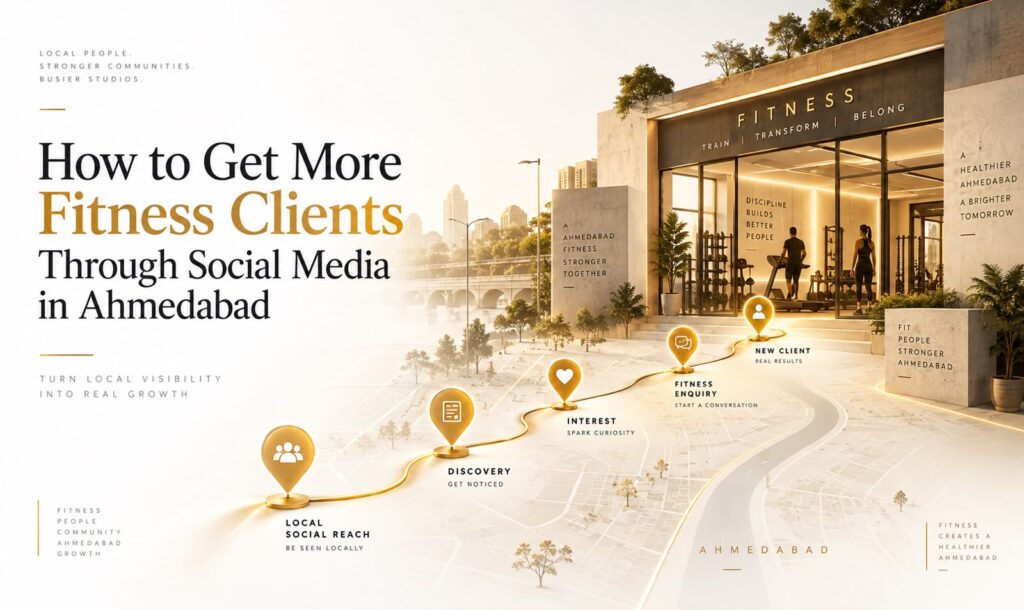
Social Media Marketing for Fitness in Ahmedabad can help gyms, trainers, studios, and wellness businesses attract local customers, generate qualified leads, increase memberships, and drive sustainable business growth. But simply posting workout videos, motivational quotes or membership posters does not automatically generate paying clients.
The real opportunity is to build a social media system you need digital marketing agency in Ahmedabad that moves a person from discovering your fitness business to trusting your expertise, making an enquiry, booking a trial or consultation, and eventually becoming a paying client.
This is particularly important in Ahmedabad because fitness customers are not one homogeneous audience. A student looking for an affordable gym, a working professional searching for personal training near the office, a beginner who feels uncomfortable in a large gym, and someone looking for premium strength coaching may all have completely different expectations.
Therefore, the strategy should not be:
“How can I get more followers?”
It should be:
“How can I consistently reach the right people in Ahmedabad, give them a reason to trust my business, and make it easy for them to become customers?”
A practical social media funnel can look like this:
Local discovery → Fitness content → Profile visit → Trust → Enquiry → Qualification → Trial/consultation → Membership or training package → Retention → Referral
This article explains how fitness businesses can build that system using Instagram, Facebook, short-form video, paid social advertising, WhatsApp, Google Business Profile, websites and lead tracking.

Why Do Fitness Businesses Need Local Social Media Marketing in Ahmedabad?
Local social media marketing is important for fitness businesses because most gyms and personal trainers serve a geographically limited customer base. Someone may love a gym’s Instagram content, but if the location is inconvenient, they may never become a customer. Working with a Social Media Marketing Agency in Ahmedabad can help gyms and personal trainers reach potential customers in relevant local areas, showcase their facilities and services, build engagement, and turn social media visibility into genuine local enquiries and memberships.
For a fitness business in Ahmedabad, the objective is therefore not simply to reach the largest possible audience. It is to reach people who are realistically capable of becoming customers.
Consider a gym operating in South Bopal. Content reaching someone in another city may contribute to a high view count but does little for membership acquisition. In contrast, reaching people who live, work or regularly spend time around South Bopal, Bopal, Shela or nearby areas may create considerably more relevant opportunities.
However, local marketing does not mean adding “Ahmedabad” to every caption.
A strong local strategy combines several elements:
* Accurate business location
* Clearly communicated service area
* Localised social content
* Relevant Ahmedabad examples
* Genuine customer stories
* Trainer introductions
* Local paid advertising where appropriate
* Google Business Profile
* Local website content
* Easy WhatsApp or enquiry options
* Genuine reviews and testimonials
Google explains that local search results are primarily influenced by relevance, distance and prominence. Complete and accurate business information can help Google understand a local business and connect it with relevant searches.
Social media can support this local discovery process by showing what the business actually looks like.
For example, instead of publishing only generic stock images of muscular people, an Ahmedabad gym can show:
* Its actual entrance
* Actual equipment
* Actual trainers
* Actual classes
* Actual members, with permission
* Actual training environment
* Local events
* Frequently asked questions
* Membership process
This creates familiarity before the customer visits.
Local social media marketing is particularly valuable for new fitness businesses because it can introduce the business to the surrounding community before people have developed awareness of the brand.
The most important principle is simple:
Local visibility should lead to local relevance, and local relevance should lead to a clear customer action.
A fitness business should therefore judge social media not only by how many people saw its content, but by whether the right people are discovering the business and taking meaningful next steps.
What Type of Fitness Content Attracts Local Customers in Ahmedabad?
Fitness content attracts potential customers when it helps them solve a problem, understand a service, evaluate a business or feel confident about taking the next step. A successful fitness content strategy should therefore go beyond repetitive workout demonstrations.
The strongest approach is to create different content for different stages of the customer’s decision-making process.
At the awareness stage, people may not even know your gym or trainer. Educational Reels, exercise demonstrations, beginner tips, common fitness mistakes and locally relevant fitness topics can help introduce the brand.
At the consideration stage, people want to understand whether your business is suitable for them. This is where trainer introductions, facility tours, class demonstrations, FAQs, membership explanations and genuine client experiences become important.
At the conversion stage, people need a reason and an easy way to take action. Trial sessions, consultations, membership information, introductory packages and clear enquiry instructions can help.
A useful content mix could include:
Content Purpose
Workout Reels Reach and education
Beginner fitness tips Reduce uncertainty
Trainer videos Build expertise and familiarity
Gym tours Show the actual environment
Member stories Demonstrate genuine experiences
FAQs Remove objections
Membership information Support evaluation
Fitness challenges Encourage participation
Behind-the-scenes content Humanise the business
Offers Encourage action
For example, instead of repeatedly publishing:
“Do these 5 exercises for abs.”
a personal trainer could create:
“What should a complete beginner expect during their first personal-training session?”
The second topic is closer to a potential customer’s decision-making process.
An Ahmedabad gym can also create locally relevant content without forcing local keywords into every post. Examples include:
* “How to maintain your workout routine with a busy Ahmedabad work schedule”
* “What beginners should know before joining a gym”
* “Morning vs evening workouts for working professionals”
* “How to choose a personal trainer”
* “What to check before joining a fitness studio”
The content should always be truthful. Transformation posts should feature real customers who have given appropriate permission. Results should not be presented as guaranteed outcomes for everyone.
The best fitness content ultimately answers questions such as:
Can you help me?
Do you understand my situation?
What will working with you actually be like?
Can I trust this trainer or gym?
What should I do next?
When content consistently answers those questions, social media becomes more than a publishing platform. It becomes an education and conversion channel.
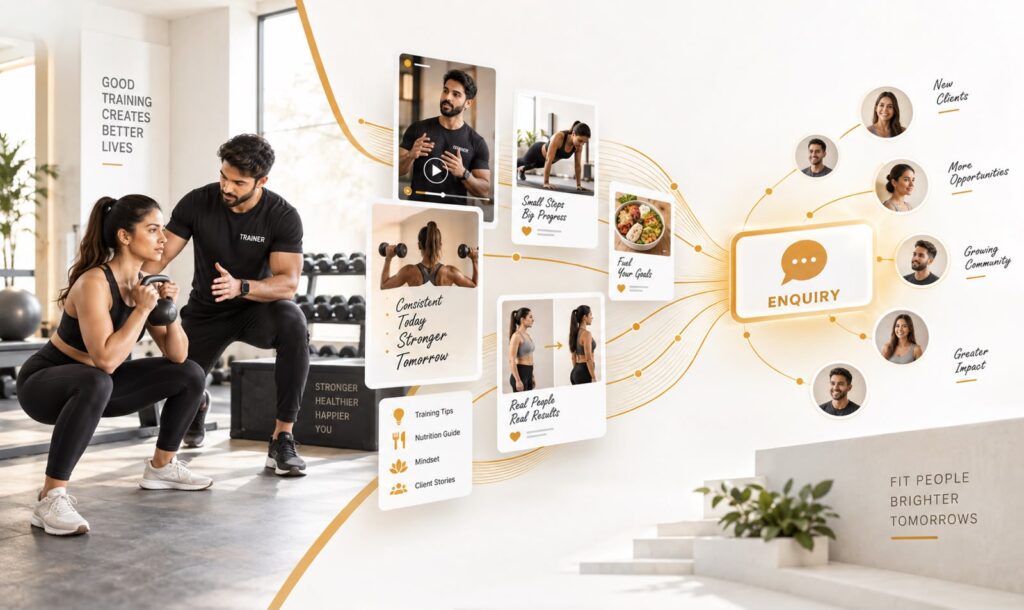
How Can Personal Trainers Generate More Enquiries Through Social Media?
Personal trainers can generate more enquiries through social media by clearly positioning themselves around a specific audience, problem or training service and then creating content that demonstrates their expertise and makes the next step easy.
One of the biggest mistakes personal trainers make is creating profiles that explain what they do but not who they help.
For example:
“Certified Fitness Trainer | Fitness | Workout | Transformation”
does not tell a potential customer much about the actual service.
A stronger profile might communicate:
“Personal Trainer in Ahmedabad | Beginner Strength Coaching | 1-to-1 Training | Bopal & South Bopal”
The exact wording should reflect the trainer’s real qualifications, service area and offering.
Once positioning is clear, content should reinforce it.
If the trainer wants beginner clients, create beginner-oriented content.
If the trainer specialises in strength training, demonstrate coaching technique and explain strength principles.
If the trainer offers home personal training, show how sessions work.
If the trainer works with corporate professionals, create content around practical training schedules for working people.
A personal trainer can build an enquiry funnel such as:
Reel → Profile → Pinned information → Service explanation → DM/WhatsApp → Consultation → Trial/session → Paid package
Pinned posts can be especially useful because a new visitor can immediately find:
1. Who the trainer is
2. What service is offered
3. Who the service is designed for
4. How the training process works
5. How to enquire
The trainer can also make enquiries easier by asking useful qualifying questions.
For example:
“Tell me your area, fitness goal, preferred training time and whether you are looking for gym-based or home training.”
This gives the trainer enough context to continue the conversation intelligently.
A person who asks “fees?” should not necessarily receive only a price.
The trainer can respond by first understanding the requirement and then explaining the relevant package.
This does not mean avoiding transparent pricing. It means ensuring that price is considered alongside the service being purchased.
Personal trainers should also use real proof where available:
* Genuine client feedback
* Real training footage
* Actual coaching sessions
* Trainer qualifications
* Educational demonstrations
* Client progress stories with permission
The goal is not to manufacture authority. It is to make genuine expertise visible.
Ultimately, a personal trainer does not need every follower to become a client. The objective is to attract relevant local prospects and create enough trust for them to begin a genuine conversation.

How Can Gyms Promote Their Membership Plans on Social Media?
Gyms can promote membership plans more effectively when they explain the value and experience behind the membership rather than publishing repeated discount graphics.
A potential customer rarely evaluates a gym based only on price. They may also consider:
* Location
* Equipment
* Opening hours
* Trainers
* Cleanliness
* Crowd
* Training environment
* Personal-training availability
* Group classes
* Parking
* Membership flexibility
* Overall atmosphere
Therefore, social media should answer these questions before repeatedly asking the audience to join.
A gym can create a membership content sequence.
First, introduce the facility through a short video tour.
Then introduce trainers and explain their roles.
Next, demonstrate classes or training sessions.
Then publish a simple membership explanation.
For example:
What does a regular membership include?
Who is it suitable for?
What facilities are available?
What are the operating hours?
Are personal-training sessions separate?
How can someone visit the gym before joining?
This information reduces uncertainty.
The gym can then introduce an appropriate offer.
Potential formats include:
* Trial session
* Introductory consultation
* New-member package
* Group-class trial
* Referral programme
* Seasonal membership campaign
* New-branch launch offer
* Fitness assessment
The exact offer should depend on the business model.
A discount is not always the best offer. For example, a premium personal-training studio may benefit more from a consultation or assessment than from a large price reduction.
Similarly, a new gym might use an introductory visit to help people experience the facility before asking them to commit.
Every social-media membership campaign should have a clear CTA.
Examples include:
Book a gym visit
Message us for membership options
Book an introductory session
WhatsApp the team
Schedule a consultation
Avoid vague CTAs such as “DM us now!!!” if the customer does not know what they will receive after sending the message.
The next step should be obvious.
The gym should also track which membership campaign produces meaningful results. A post with 100,000 views may generate fewer customers than a smaller post that reaches 5,000 highly relevant local people.
Therefore, the business should monitor:
* Enquiries
* Qualified leads
* Visits
* Trial bookings
* Trial attendance
* Membership conversions
* Revenue
* Cost per acquired customer
Social media should ultimately support the membership sales process rather than becoming a collection of promotional posters.
How Can Fitness Trainers Turn Social Media Enquiries Into Paid Clients?
Generating enquiries is only one part of fitness marketing. A business can receive dozens of Instagram DMs and still acquire very few paying customers if its follow-up process is inconsistent.
A fitness business should therefore create a simple process for handling enquiries.
A useful framework is:
Respond → Understand → Qualify → Recommend → Invite → Follow up
Suppose someone sends:
“Hi, I want personal training. Fees?”
A weak response would simply send a price list.
A stronger response could begin:
“Hi! Happy to help. Are you looking for gym-based personal training or home sessions? Also, which area are you located in and what is your main fitness goal?”
The purpose is not to avoid answering the price question. The purpose is to understand what the customer actually needs.
Once the requirement is understood, the business can explain the appropriate service.
For example:
Customer: Beginner, lives near the gym, wants structured strength training.
Trainer: Explains beginner programme, session format, availability, consultation process and pricing.
Next step: Book consultation or trial.
This creates a more meaningful sales conversation.
A simple lead-tracking system can help.
Lead Source Requirement Area Stage Next Action
A Instagram Reel Personal training Bopal New enquiry Call
B Instagram Ad Gym membership Satellite Trial booked Confirm
C Facebook Group class Vastrapur Qualified Visit
D WhatsApp PT Thaltej Consultation Follow up
Lead stages can include:
New → Contacted → Qualified → Consultation → Trial → Won → Lost → Follow-up
This allows the business to identify where leads are dropping.
For example, if 50 people enquire but only 10 attend trials, the problem may not be the social-media content. It may be the follow-up or booking process.
If 20 people attend trials but only 2 purchase, the business may need to examine the service presentation, pricing, customer experience or offer.
This is why social media performance should not be analysed separately from sales performance.
The business should also establish reasonable follow-up procedures. Some prospects need time to decide, compare options or discuss the purchase with family members.
Follow-up can therefore include:
* Confirmation messages
* Helpful information
* Trial reminders
* Answers to unanswered questions
* Relevant programme details
* A final polite follow-up
The objective is to make the decision easier, not pressure the customer.
A successful social-media strategy therefore does not stop at “DM received.”
It continues until the prospect either becomes a customer, remains in a qualified follow-up pipeline or clearly decides not to proceed.
Why Do Gym Followers Not Always Become Paying Members?
Gym followers do not automatically become paying members because social-media attention and purchase intent are different things. A person can enjoy fitness content, follow a trainer and watch gym Reels regularly without currently having any intention to purchase a membership.
This is one reason follower count should not be treated as the main indicator of social-media success.
There are several reasons why a large follower base may generate relatively few customers.
The first is audience mismatch.
A Reel may go viral outside Ahmedabad or attract people interested in entertainment rather than gym membership. The content performs well, but the audience is not commercially relevant.
The second is unclear positioning.
If a profile contains workout videos but does not clearly explain:
* Where the gym is
* What services it provides
* Who it serves
* What makes it different
* How someone can join
the visitor may simply leave.
The third is low purchase intent.
Someone following a fitness account today may be planning to join a gym three months later.
The fourth is lack of trust.
Fitness is a personal service. Customers may want to see real trainers, facilities, member experiences and evidence that the business actually provides the advertised service.
The fifth is conversion friction.
If the customer cannot easily find the phone number, WhatsApp option, membership information or booking process, the opportunity can disappear.
The sixth is overdependence on discounts.
A constant stream of offers may attract price-sensitive audiences without communicating the actual value of the fitness service.
A useful way to understand the problem is:
Followers are an audience.
Enquiries are opportunities.
Qualified leads are potential customers.
Trials and consultations are stronger buying signals.
Paid memberships are business outcomes.
Therefore, a fitness business should measure the journey.
For example:
10,000 followers → 400 profile visits → 80 enquiries → 35 qualified leads → 20 trials → 8 memberships
This tells a much more useful story than “We gained 1,000 followers.”
The opposite can also happen:
2,000 followers → 50 enquiries → 20 qualified leads → 10 memberships
In this situation, the smaller account may have stronger commercial relevance.
The lesson is not that follower growth is useless. Reach and audience growth can contribute to future demand.
The lesson is that followers should not be confused with customers.
A good social strategy balances reach with relevance, trust and conversion.

How Can Fitness Brands Stand Out From Other Gyms in Ahmedabad?
Fitness brands can stand out in Ahmedabad by developing a clear and credible reason for the right customer to choose them instead of relying entirely on discounts, generic fitness slogans or claims such as “best gym.”
The first step is identifying what the business genuinely does well.
Possible positioning areas include:
* Beginner-friendly training
* Strength training
* Personal training
* Small-group training
* Women’s fitness
* Functional training
* Premium fitness facilities
* Home personal training
* Corporate fitness
* Sports conditioning
* Mobility training
* Senior fitness
* Specialised coaching
The business should not claim specialisation unless it genuinely offers that service.
For example, a gym might position itself around:
“Structured strength training for beginners in South Bopal.”
That statement is much more useful than:
“Ahmedabad’s ultimate fitness destination.”
The first communicates audience, service and location.
The next step is to make that positioning visible throughout the content.
If the business is beginner-focused, create:
* Beginner workout videos
* Gym etiquette content
* First-session explanations
* Trainer introductions
* Beginner FAQs
* “What to expect” videos
If the business focuses on personal training, create:
* Coaching demonstrations
* Session walkthroughs
* Client experiences
* Training-plan explanations
* Progress-tracking content
If the business is premium, show the actual experience rather than simply describing it as premium.
Show:
* Facilities
* Equipment
* Environment
* Trainer interaction
* Service process
* Customer experience
Authenticity becomes particularly important here.
A business should use genuine photographs, videos, testimonials and customer stories wherever possible.
Competitor research can identify what other Ahmedabad fitness businesses are promoting, but copying their content will not create differentiation.
Instead, look for gaps.
For example:
If competitors mostly post discounts, create educational content.
If competitors mostly show equipment, show the coaching experience.
If competitors focus heavily on advanced athletes, create beginner-friendly content.
If competitors promote only membership pricing, explain the complete customer experience.
This creates a more meaningful competitive position.
The goal is not to convince every Ahmedabad resident that the business is the right choice.
The goal is to make the right potential customer think:
“This looks like the type of fitness business I was searching for.”
That is stronger positioning than attempting to appeal to everyone.
What Social Media Offers Can Help Gyms Get More New Members?
Social-media offers can help gyms generate new-member enquiries when the offer reduces uncertainty, provides a clear reason to take action or allows a potential customer to experience the service before making a larger commitment.
However, every gym does not need to offer a large discount.
A discount can create immediate interest, but it may also attract customers who are primarily comparing prices. For a long-term fitness business, it can sometimes be more useful to offer an experience that demonstrates value.
Possible offers include:
* Free or paid trial session
* Introductory consultation
* Fitness assessment
* Beginner orientation
* First group class
* New-member package
* Referral incentive
* Couple membership
* Student package
* Corporate fitness package
* Limited launch package
* Personal-training consultation
For example, instead of:
50% OFF — JOIN TODAY!
a gym could communicate:
New to strength training? Book an introductory session and understand how our beginner programme works.
The second offer creates a reason to interact with the business while also positioning the gym around a specific customer need.
The offer should always have clear terms.
A prospect should be able to understand:
* Who is eligible
* What is included
* How long the offer lasts
* Whether it applies to new customers
* How to book
* What happens after the trial
Avoid fake urgency.
If a campaign says “only 3 spots left,” that should be factually true.
The business should also track the offer through a specific conversion path.
For example:
Instagram Reel → Offer → WhatsApp → Trial → Membership
or:
Meta Ad → Lead Form → Sales Call → Gym Visit → Membership
Then calculate the actual commercial outcome.
Suppose an offer produces:
* 100 leads
* 50 qualified prospects
* 25 trials
* 15 attended trials
* 6 memberships
The gym can compare the cost of the campaign against the resulting customers.
This is far more useful than saying:
“Our campaign got 200,000 impressions.”
The right offer also depends on the business’s positioning.
A premium personal-training studio may not want a huge discount.
A new gym may need an introductory experience.
A group fitness studio may promote a first class.
A mature gym may focus on referrals.
Therefore, the question should not be:
“What discount are other gyms giving?”
It should be:
“What first step makes sense for our target customer and our business model?”
That approach makes social-media offers more sustainable.
How Can Social Media Help New Gyms Build a Customer Base in Ahmedabad?
New gyms can use social media to build awareness, familiarity and community before and after opening. The biggest advantage for a new fitness business is that it can document its development and invite local people into the story instead of appearing suddenly with only a membership advertisement.
Before opening, content can introduce:
* The location
* Brand identity
* Construction progress
* Equipment
* Trainers
* Classes
* Training philosophy
* Opening date
* Membership options
* Frequently asked questions
For example, a Reel showing equipment arriving at the new facility can generate curiosity.
A trainer introduction can start building familiarity.
A walkthrough of the location can reduce uncertainty.
An explanation of the training philosophy can differentiate the gym before the first membership is sold.
During launch, the business can publish:
* Gym tours
* Opening-day content
* Trial information
* Trainer demonstrations
* First classes
* Local collaborations
* Customer questions
* Introductory offers
After launch, the content should gradually move away from:
“We are opening.”
towards:
“This is the community and experience we provide.”
Show genuine members, classes and training sessions with appropriate consent.
Create educational content.
Answer questions.
Introduce trainers.
Show progress.
Celebrate legitimate member milestones.
This creates social proof without manufacturing it.
A new gym should also build its local search presence. Google Business Profile can help eligible businesses appear on Google Search and Maps and provide information such as location, hours, phone number, website, photos and reviews.
This matters because customers do not always follow a straight social-media journey.
Someone might:
See Instagram Reel → Search gym name on Google → Check Maps → Read reviews → Visit website → Return to Instagram → WhatsApp
Therefore, the brand should be consistent across platforms.
The business name, location, services, opening hours and contact details should be accurate and consistent.
A new gym can also build relationships with relevant local businesses, housing communities, corporate offices, sports groups and wellness professionals where appropriate.
The objective should be to become visible within the surrounding community.
A new gym does not necessarily need massive social reach immediately.
It needs to become recognisable and credible among the people most capable of becoming its customers.
That is a much more practical foundation for long-term local customer acquisition.
How Can Fitness Businesses Track Leads and Sales From Social Media?
Fitness businesses should track social media according to the complete customer journey rather than stopping at likes, comments or follower growth.
The basic measurement framework should be:
Reach → Profile Visit → Enquiry → Qualified Lead → Trial/Consultation → Paid Customer → Revenue
Each stage provides different information.
For example, high reach with low profile visits may indicate that content is entertaining but not creating enough interest.
High profile visits with few enquiries may indicate that the profile lacks a clear offer or CTA.
High enquiries with few qualified leads may indicate audience targeting problems.
Many qualified leads but few trials may indicate follow-up or booking problems.
Many trials but few memberships may indicate an issue further down the conversion journey.
A simple lead sheet can contain:
Lead Source Area Goal Service Stage Follow-up
A Instagram Reel Bopal Strength PT Trial Confirm
B Meta Ad Satellite General fitness Membership Qualified Call
C Instagram Story Vastrapur Beginner Group class New Reply
D Google Thaltej PT Personal training Consultation Follow up
Lead sources should be recorded wherever practical:
* Instagram organic
* Instagram Reel
* Instagram Story
* Facebook
* Meta Ads
* Google Search
* Google Business Profile
* WhatsApp
* Website
* Referral
* Walk-in
For paid campaigns, platform analytics can provide useful campaign-level information, but the fitness business should also maintain its own records because the platform does not know the full offline sales outcome in every situation.
Important business metrics include:
Cost per lead
How much advertising spend was required to generate an enquiry?
Cost per qualified lead
How much was required to generate a prospect who actually fits the target customer profile?
Cost per acquisition
How much was spent to acquire a paying member?
Lead-to-customer conversion rate
What proportion of qualified leads became customers?
Customer value
How much revenue does a new customer generate over the relevant relationship period?
This allows the business to compare channels.
For example, Instagram might generate many enquiries, while Google Search generates fewer but more commercially specific enquiries.
Neither channel should automatically be considered superior without looking at the actual business outcome.
Tracking also helps content strategy.
If trainer videos consistently produce enquiries while generic workout posts produce views but no leads, the business can adjust its content mix.
Similarly, if a particular membership offer produces many leads but very few memberships, the business can investigate lead quality or offer positioning.
The purpose of tracking is not to make marketing unnecessarily complicated.
It is to answer one practical question:
“Which activities are helping us acquire real customers?”
Once the business can answer that question, social media becomes a measurable acquisition channel rather than simply a content-publishing activity.
How Can Fitness Businesses Build a Complete Social Media Lead-Generation Funnel?
A complete fitness social-media funnel should connect content, advertising, profiles, landing pages, messaging and sales follow-up into one continuous customer journey.
The first stage is awareness.
A potential customer discovers the fitness business through a Reel, Story, Facebook post, paid advertisement, YouTube video, local recommendation or search.
The second stage is interest.
The customer visits the profile and looks for information about the business.
This is where the profile needs to communicate:
* Location
* Services
* Audience
* Trainers
* Facilities
* Contact method
The third stage is trust.
The prospect consumes:
* Educational content
* Trainer videos
* Gym tours
* Genuine testimonials
* Member stories
* FAQs
* Demonstrations
The fourth stage is conversion.
The prospect is offered an easy action:
* WhatsApp
* Call
* DM
* Consultation
* Trial
* Website enquiry
* Booking
The fifth stage is qualification.
The business understands the prospect’s:
* Goal
* Location
* Preferred service
* Availability
* Experience
* Requirements
The sixth stage is experience.
The customer visits the gym, attends a trial or participates in a consultation.
The seventh stage is purchase.
The business recommends the relevant membership or training package.
The eighth stage is retention.
The business continues to provide value through:
* Progress tracking
* Community
* Challenges
* Education
* Communication
* Customer support
The ninth stage is referral.
Satisfied customers may recommend the business to friends, colleagues or family members.
This creates a much more complete model:
Content → Attention → Trust → Enquiry → Qualification → Experience → Sale → Retention → Referral
Each stage requires different content.
Stage Suitable content
Awareness Reels, educational posts
Interest Trainer/facility content
Trust Testimonials, genuine member stories
Conversion Offers, trials, consultations
Qualification Forms, WhatsApp questions
Experience Trial session
Retention Community and progress content
Referral Member appreciation
This structure also makes marketing problems easier to diagnose.
If there is no reach, examine content and targeting.
If there is reach but no profile interest, examine positioning.
If there are profile visits but no enquiries, examine the offer and CTA.
If there are enquiries but no sales, examine qualification and follow-up.
If there are sales but poor retention, examine the customer experience.
This is much more actionable than simply saying that the gym “needs better social media.”
What Are the Biggest Social Media Marketing Mistakes Fitness Businesses in Ahmedabad Should Avoid?
Fitness businesses can lose potential customers when their social-media strategy focuses too heavily on appearance and too little on customer decision-making.
One common mistake is chasing followers instead of relevant customers. A large audience is not automatically valuable if much of it is outside the business’s service area or has no interest in purchasing fitness services.
Another mistake is posting generic content without positioning. If every gym publishes the same motivational quote, exercise Reel and transformation graphic, the customer has little reason to remember one brand over another.
A third mistake is using exaggerated claims.
Fitness businesses should avoid unsupported promises such as guaranteed weight loss, guaranteed transformations or unrealistic timelines. Marketing should represent the service accurately.
Another issue is poor profile optimisation.
A potential customer should not have to search through dozens of posts to discover:
* Where the gym is
* What it offers
* Who the trainers are
* Who it serves
* How to contact it
Another common problem is posting only promotional content.
If every post says “Join Now,” the audience receives very little value before being asked to purchase.
A better balance includes:
* Education
* Proof
* Personality
* Community
* Service information
* Offers
Businesses should also avoid fake testimonials or fabricated transformations. Trust is particularly important in fitness because customers are purchasing a service that can affect their routines, confidence and expectations.
Another mistake is ignoring lead follow-up.
A marketing campaign can generate excellent enquiries, but if the business replies slowly or inconsistently, the investment may not translate into customers.
Another issue is not measuring outcomes.
If the business only tracks:
* Likes
* Followers
* Views
it cannot determine whether social media is generating business.
Instead, track:
Enquiries → Qualified leads → Trials → Memberships → Revenue
Finally, businesses should avoid keyword stuffing in captions and website content. Adding “gym in Ahmedabad” repeatedly does not create genuine local relevance.
Google’s Search Essentials and people-first guidance emphasize creating useful content and avoiding manipulative search practices.
A strong fitness brand should therefore focus on:
Authenticity + Local relevance + Useful content + Clear positioning + Easy conversion + Consistent follow-up + Measurable outcomes.
That combination is considerably more sustainable than chasing short-term engagement.
What Should Fitness Businesses in Ahmedabad Do First to Get More Clients Through Social Media?
The first step should be to define the ideal local customer and the exact service being promoted before creating more content.
A gym should not begin with:
“What should we post today?”
It should begin with:
“Which customer are we trying to acquire, what do they need, and why would they choose us?”
For example:
Audience: Beginners around South Bopal
Problem: Intimidated by traditional gym environments
Service: Beginner strength programme
Content: Beginner education, trainer introductions, first-session explanations
Offer: Introductory session
CTA: Book a visit
A different gym might target:
Audience: Working professionals
Problem: Difficulty maintaining a consistent routine
Service: Structured personal training
Content: Time-efficient workouts, trainer coaching, scheduling
Offer: Consultation
CTA: Book a consultation
Once the audience and offer are defined, optimise the social profile.
Then build several content pillars:
Education
Teach something useful.
Expertise
Show how trainers actually coach.
Proof
Use genuine customer experiences.
Experience
Show the actual gym environment.
Conversion
Explain services and relevant offers.
The next step is to create a simple enquiry process.
A customer should be able to move from:
Instagram → WhatsApp/DM → Qualification → Trial/Consultation
without unnecessary friction.
Then establish lead tracking.
Record:
* Source
* Location
* Requirement
* Lead status
* Follow-up
* Outcome
After collecting enough information, analyse which content and campaigns produce qualified customers.
This creates a feedback loop:
Publish → Measure → Learn → Improve → Publish again
Paid advertising can then be introduced or scaled when the business has a clear audience, offer and conversion process.
Local search should also be included. An accurate Google Business Profile, useful website, genuine reviews and consistent business information can support discovery beyond social media. Google notes that local search visibility depends on factors including relevance, distance and prominence.
The important point is that fitness marketing should not begin with the platform.
It should begin with the customer and the business objective.
Instagram, Facebook, Google, WhatsApp and the website are channels used to achieve that objective.
Conclusion:- How to Get More Fitness Clients Through Social Media in Ahmedabad
Getting more fitness clients through social media in Ahmedabad is not simply a matter of posting more frequently or increasing follower count. The stronger approach is to build a complete customer-acquisition system around the people most likely to become customers.
A successful strategy can be summarised as:
Understand the local audience → Position the fitness business clearly → Create useful content → Demonstrate genuine expertise → Build trust → Provide a relevant offer → Make enquiries easy → Follow up consistently → Track conversions → Improve the strategy.
For gyms, this may mean combining facility content, trainer videos, membership information, trial offers and local advertising.
For personal trainers, it may mean building a specialised profile, demonstrating coaching expertise, explaining the training process and converting DMs into consultations.
For new fitness studios, it may mean using social media to build awareness before launch and community after launch.
For established fitness businesses, it may mean improving the connection between content, leads, sales and retention.
The most important change is to stop thinking about social media purely as a content channel.
Think of it as part of a wider local customer journey.
A potential customer may discover a Reel, visit the profile, search the business on Google, examine reviews, visit the website, send a WhatsApp message, attend a trial and eventually purchase a membership.
Every stage matters.
The objective is therefore not:
More followers at any cost.
It is:
More relevant local attention for Gyms in Ahmedabad can lead to more qualified enquiries, more trial sessions and consultations, more paying fitness clients, and stronger long-term relationships with members.
When social media, local search, website content, messaging and sales follow-up work together, a fitness business can create a much more measurable and sustainable client-acquisition process.
For businesses that want to scale this process, combining social media marketing, local SEO, content marketing, lead generation, Google Ads and conversion-focused website development can create a broader digital marketing ecosystem instead of relying on one platform alone.
Frequently Asked Question
You can attract more fitness clients by targeting a specific local audience, creating useful fitness content, showcasing genuine client results, optimising your social profiles, using relevant offers and making it easy for prospects to contact you through Instagram, WhatsApp or your website.
Instagram and Facebook can be effective for fitness businesses because they support visual content such as Reels, Stories, testimonials, gym tours and advertisements. The right platform depends on your target audience, location, services and marketing objectives.
Personal trainers can attract clients by clearly explaining their speciality, creating educational Reels, demonstrating their coaching expertise, sharing genuine client experiences and using clear calls to action. DMs can then be used to understand the prospect’s goals and guide them toward a consultation or trial session.
Promote your gym by showcasing its facilities, trainers, classes, customer experiences, educational content and membership options. Instead of relying only on discounts, use relevant trial sessions, consultations or introductory offers and direct interested prospects toward a simple enquiry process.
You can generate gym leads through organic content, Instagram and Facebook advertising, lead forms, WhatsApp campaigns, trial offers and consultation bookings. Track each enquiry from its original source through qualification, trial attendance and membership conversion.
Followers may not become customers if they are outside your service area, have low purchase intent, do not understand your services or cannot easily find information about pricing, location and booking. Focus on attracting relevant local prospects and measuring enquiries, qualified leads, trials and memberships rather than follower count alone.
Gyms can post workout education, beginner fitness tips, trainer introductions, facility tours, FAQs, genuine member stories, class demonstrations, behind-the-scenes content and relevant membership offers. A balanced content strategy should build awareness, trust and conversion rather than promoting memberships in every post.
Use your actual business location and service areas across your social profiles, Google Business Profile and website. Create locally relevant content and, where appropriate, use location-based advertising to reach people who live or work near your gym.
Start by understanding the person’s location, fitness goal, preferred service and requirements. Then recommend the appropriate service, explain the next step and invite them to a consultation, trial or gym visit. Consistent and helpful follow-up can also improve the chances of converting qualified enquiries.
There is no single budget that works for every gym. The appropriate investment depends on the target audience, location, competition, service pricing, campaign objective and available customer-acquisition budget. Instead of focusing only on ad spend, track cost per lead, qualified leads, customer acquisition cost and revenue generated.
Track the complete customer journey from reach and profile visits to enquiries, qualified leads, trials, consultations, memberships and revenue. Recording the source of each lead—such as Instagram, Facebook, Meta Ads, Google, WhatsApp or referrals—helps identify which marketing activities are producing actual customers.