
Digital Marketing for Automobile Industry in Ahmedabad plays a key role in shaping the customer journey, as a showroom visit is often not the beginning of the buying process but the result of a digital journey that may have started days or even weeks earlier with a Google search. Partnering with a Digital Marketing Agency in Ahmedabad can help automobile businesses build a stronger online presence, reach potential buyers during their research phase, showcase vehicles and offers, and encourage more customers to take the next step toward a showroom visit.
A customer may search for a particular car model, compare two SUVs, check an approximate price, look for an authorised dealer, read reviews, watch a test-drive video, search for offers, calculate EMI, find a nearby showroom or enquire about availability. Someone looking for an after-sales service may search for a car service centre, repair workshop, tyre service, battery replacement or AC repair before ever contacting the business.
This makes Google an important pre-showroom discovery and research channel.
Current automotive marketing pages in Ahmedabad increasingly emphasize the same connected journey: local search, dedicated vehicle pages, Google Ads, test-drive enquiries, landing pages, reviews, WhatsApp and CRM follow-up rather than treating SEO or advertising as isolated activities.
At the same time, dealership websites are already moving beyond static brochures. Ahmedabad dealership websites provide features such as model comparisons, EMI calculators, quote forms, location information and test-drive actions.
The opportunity for an automobile business is therefore not simply:
“How do we rank on Google?”
A better question is:
“How can we help a potential customer complete more of their vehicle research online and make the showroom visit the natural next step?”
A useful digital customer journey is:
Google Search → Vehicle Discovery → Website → Research → Comparison → Trust → Enquiry → Test Drive → Showroom Visit → Purchase
For service businesses, the journey changes slightly:
Google Search → Service Discovery → Reviews → Service Page → Call/Booking → Workshop Visit → Service → Review → Repeat Visit
This article explains how automobile businesses in Ahmedabad can build that journey using SEO, Google Business Profile, vehicle-specific content, test-drive pages, seasonal campaigns, retargeting, local SEO, service content and trust-focused digital experiences.
How Can Websites Support Test-Drive Enquiries?
A dealership website can support test-drive enquiries by making the transition from vehicle research to appointment booking as simple and relevant as possible. A customer searching for a specific model should not have to navigate through a generic homepage, locate the model, search for contact information and then figure out how to request a test drive.
The test-drive action should be visible at the exact point where purchase interest develops.
For example, imagine a customer searches:
“SUV automatic test drive Ahmedabad”
The ideal journey is:
Google Search → Relevant SUV/model page → Key information → Test-drive CTA → Enquiry form → Confirmation/follow-up
Instead, sending the visitor to a generic homepage creates unnecessary steps.
A strong test-drive page can contain:
* Vehicle/model name
* Key features
* Variant information
* Important specifications
* Relevant images or videos
* Dealership location
* Opening hours
* Test-drive availability
* Preferred date/time field
* Customer name and contact details
* Preferred model/variant
* Call or WhatsApp option
* Directions
* Relevant terms and conditions
The form itself should balance lead qualification with convenience. Asking for excessive information can discourage enquiries, while collecting too little information can make sales follow-up inefficient.
A dealership can also create different test-drive entry points.
For example:
Model Page: “Book a Test Drive”
Google Search Ad: “Schedule Your [Model] Test Drive”
Google Business Profile: Website/appointment action
Comparison Page: “Compare Models → Experience Your Preferred Model”
Offer Page: “Check Offer → Book Test Drive”
This creates multiple paths to the same business objective.
Current Ahmedabad dealership websites demonstrate this direction. For example, NEXA dealership pages provide test-drive actions alongside showroom/location information and vehicle-related enquiry functionality.
The important SEO principle is that the page should satisfy the user’s intent before asking for conversion.
A customer should understand:
What vehicle am I enquiring about?
Where is the dealership?
How can I request the test drive?
What happens after I submit the form?
This turns the website from a digital brochure into a pre-sales tool.
For an automobile business, test-drive tracking should also be connected with the sales process where possible. The marketing team should ideally know not only how many people clicked “Book Test Drive,” but how many enquiries were contacted, appointments were scheduled and test drives actually occurred.
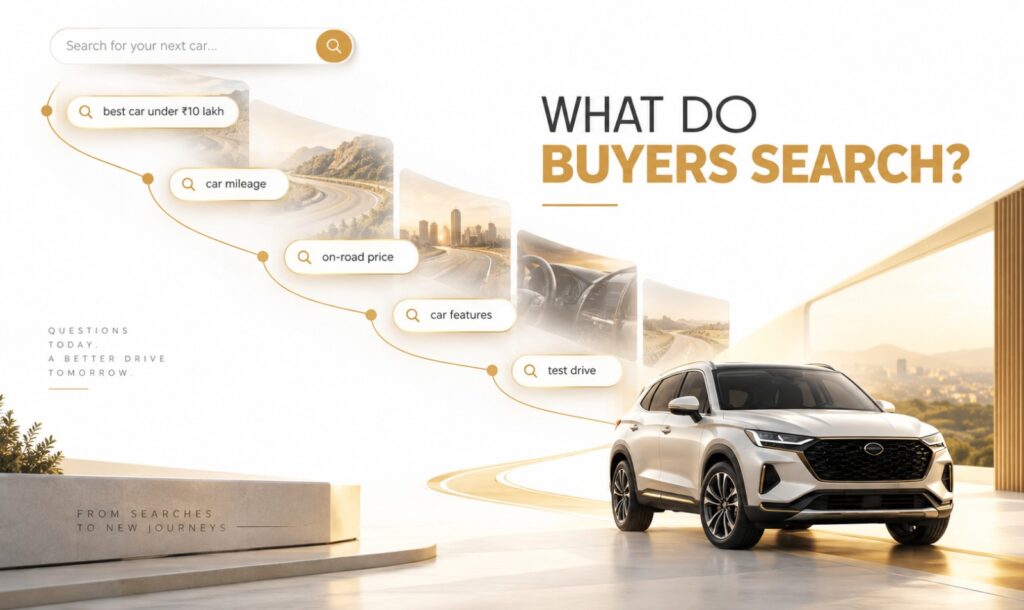
What Do Customers Search on Google Before Buying a Car or Vehicle?
Customers rarely use only one search query throughout their vehicle-buying journey. Their searches can evolve from broad research to model-specific and location-specific intent.
Understanding this progression is essential because an automobile business that targets only “car showroom Ahmedabad” misses many earlier opportunities to influence the customer.
A typical search journey can look like this:
Stage 1: General discovery
The customer may search:
* Best SUV for family
* Best car for city driving
* Best automatic car
* Best car for long-distance travel
* Best electric car
* Best car under a particular budget
At this stage, the customer may not have selected a brand.
Stage 2: Model research
The customer becomes more specific:
* [Model] features
* [Model] mileage
* [Model] variants
* [Model] price
* [Model] specifications
* [Model] automatic
* [Model] petrol
* [Model] CNG
* [Model] EV
Stage 3: Comparison
The customer searches:
* [Model A] vs [Model B]
* [Model A] alternatives
* Best SUV between [Model A] and [Model B]
* [Model] vs [Competitor]
Stage 4: Local intent
The customer begins looking for a physical business:
* [Model] dealer Ahmedabad
* [Brand] showroom Ahmedabad
* Car showroom near me
* [Model] showroom near me
Stage 5: Transactional intent
The search becomes even more specific:
* [Model] test drive Ahmedabad
* [Model] on-road price Ahmedabad
* [Model] offer Ahmedabad
* [Model] booking Ahmedabad
* [Model] dealer near me
Stage 6: Post-purchase/service intent
Later, searches can include:
* [Brand] service centre Ahmedabad
* Car service near me
* [Model] service cost
* Car repair Ahmedabad
This creates a substantial content opportunity.
A dealership website can map each search intent to a relevant page rather than expecting one page to answer everything.
Search Useful destination
Best SUV Buying guide
[Model] features Model page
[Model A] vs [Model B] Comparison page
[Model] price Ahmedabad Model/pricing page
[Model] dealer Ahmedabad Location/dealer page
[Model] test drive Ahmedabad Test-drive page
Car service Ahmedabad Service page
Used car Ahmedabad Used-vehicle inventory page
The important point is that these searches should not be treated as random keywords.
They represent different customer questions at different stages of the buying journey.
Current automotive marketing competitors are also focusing heavily on model pages, high-intent searches, local SEO, test-drive booking and dedicated landing pages, which confirms that the search-to-showroom journey is a major focus of the current market. (DriveUp Digital)
The opportunity is to go deeper than simply listing keywords.
The content should answer what the customer actually wants to know before making contact.

How Can Seasonal Campaigns Increase Showroom Enquiries?
Seasonal campaigns can increase opportunities for showroom enquiries when they connect a genuine seasonal buying reason with the right vehicle, audience, search intent and landing-page experience.
For automobile businesses, relevant periods may include festive purchasing seasons, year-end campaigns, new model launches, exchange campaigns, special manufacturer promotions or other verified commercial events.
However, a seasonal campaign should not simply become:
“Huge Offer! Visit Our Showroom Today!”
That type of message may create attention but does not necessarily answer why the customer should consider the vehicle.
A stronger campaign connects the offer to the customer’s buying journey.
For example:
Google Search
“Festive car offers Ahmedabad”
↓
Seasonal landing page
Current verified offers + eligible models + terms
↓
Vehicle pages
Features + variants + comparison
↓
Test-drive CTA
↓
Sales enquiry
↓
Showroom visit
The landing page is especially important.
If an advertisement promotes a specific seasonal campaign but takes the customer to the generic homepage, the customer has to search again for the offer.
A dedicated page can instead explain:
* Campaign name
* Applicable models
* Validity period
* Offer terms
* Eligibility
* Finance information, where applicable
* Exchange information, where applicable
* Test-drive option
* Dealership location
* Contact options
Every claim should be verified before publication because automotive pricing and promotional conditions can change.
Seasonal campaigns can also be segmented according to customer intent.
For example:
Family SUV campaign
Focus on space, practicality and relevant vehicle features.
EV campaign
Focus on EV-related ownership questions, charging considerations and test-drive opportunities.
Premium vehicle campaign
Focus on experience, features and dealership consultation.
Used-car campaign
Focus on available inventory, inspection information and transparent vehicle details.
Ahmedabad-focused automotive agencies are currently promoting seasonal campaigns, vehicle launches, EV test-drive campaigns and hyperlocal advertising as parts of broader automotive marketing programs. (Osumare)
The important lesson is that seasonal marketing should not be treated as a separate activity from SEO and conversion optimization.
The campaign should connect:
Seasonal Demand + Search Intent + Relevant Vehicle + Landing Page + Enquiry + Sales Follow-Up
A campaign becomes significantly more useful when the customer can move from discovering the offer to understanding the vehicle and requesting a test drive without unnecessary steps.
How to Retarget Interested Customers?
Retargeting can help automobile businesses reconnect with people who have already demonstrated interest but did not immediately complete an enquiry, test drive or purchase action.
Automotive buying can involve considerable research. A customer may visit a model page today, compare another vehicle tomorrow, discuss options with family members and return to the dealership website later.
That means the first website visit does not necessarily represent the end of the journey.
Google Ads provides audience capabilities that allow businesses to re-engage people who have previously interacted with their website or other digital assets, subject to Google’s policies and applicable requirements. While Google currently uses the terminology “your data segments” for these audiences, a Social Media Marketing Agency in Ahmedabad can complement these efforts by helping businesses engage relevant audiences across social platforms and maintain consistent digital communication with potential customers.
The key to effective retargeting is relevance.
A customer who viewed an SUV should not necessarily receive a generic advertisement about every vehicle sold by the dealership.
Instead, audiences can be structured around previous interactions where the advertising setup permits it.
For example:
Audience 1: Model-page visitors
Message:
“Still considering [Model]? Explore variants and request a test drive.”
Audience 2: Test-drive page visitors
Message:
“Ready to experience [Model]? Complete your test-drive enquiry.”
Audience 3: Offer-page visitors
Message:
“Review the current [Model] offer and enquire with the dealership.”
Audience 4: Service-page visitors
Message:
“Need your vehicle serviced? Book an appointment with the service centre.”
This approach creates a more connected experience.
Retargeting should also consider timing.
Someone who visited a vehicle page yesterday may have different intent from someone who visited three months ago.
Businesses should therefore consider:
* Audience recency
* Page viewed
* Vehicle category
* Conversion status
* Campaign message
* Offer validity
* Frequency
* Exclusions
Google’s documentation explains that data segments can be built from previous website interactions and that audience membership periods should be appropriate to the type of purchase being considered. (DriveUp Digital)
Automotive businesses should also avoid excessive repetition.
The objective is not to show the same advertisement to someone indefinitely.
The objective is to provide a useful next step.
A practical retargeting journey could be:
Vehicle Page Visit
→ No enquiry
→ Relevant reminder
→ Model page
→ Test-drive CTA
→ Enquiry
→ Remove from acquisition audience after conversion where appropriate
This also demonstrates why website analytics and advertising should work together.
Without understanding which pages customers visit and which actions they complete, retargeting can become generic.
With meaningful segmentation, the dealership can make its advertising more relevant to the customer’s previous interaction.

How Can Car Dealerships in Ahmedabad Attract Customers Looking for Test Drives?
Test-drive searches represent a particularly important opportunity because they indicate that the customer has moved beyond general awareness and wants to experience the vehicle.
For an Ahmedabad dealership, the objective should be to make the test-drive process easy to discover through Google and easy to complete on the website.
Potential search patterns can include:
* Car test drive Ahmedabad
* Test drive near me
* [Model] test drive Ahmedabad
* [Brand] test drive Ahmedabad
* Book test drive Ahmedabad
* SUV test drive Ahmedabad
* EV test drive Ahmedabad
* [Model] dealer Ahmedabad
Each search has slightly different intent.
Someone searching “test drive near me” may be looking for the nearest suitable dealership.
Someone searching “[Model] test drive Ahmedabad” has already identified a vehicle.
The landing experience should reflect that difference.
A dealership can create model-specific test-drive pages that contain:
* Vehicle name
* Model overview
* Key features
* Available variants
* Test-drive form
* Dealership location
* Phone number
* Directions
* Opening hours
* Relevant FAQs
* Terms and conditions
The page should also make the CTA visible without forcing users to scroll through a large amount of promotional copy.
Current Ahmedabad dealership websites already incorporate test-drive functionality directly into their digital showroom experiences. For example, local NEXA and ARENA dealership pages provide test-drive access alongside vehicle information, location information, comparisons or quote functionality. (nexaofmaninagar.com)
This is important because customers increasingly expect to complete meaningful parts of their buying journey online.
Google Business Profile is another important part of local discovery. Google explains that local results are influenced by relevance, distance and prominence and recommends maintaining complete and accurate business information. (Frameleads)
A dealership should therefore ensure that the information shown across its website and local profile is consistent.
The sales process after submission matters too.
A digital marketing campaign can generate an enquiry, but the customer still needs an effective response.
A useful internal process could be:
Lead received
→ Sales representative assigned
→ Customer contacted
→ Model and requirement confirmed
→ Test-drive appointment scheduled
→ Reminder sent
→ Test drive completed
→ Sales follow-up
Marketing and sales therefore need to work together.
Generating test-drive enquiries is only the first part of the process.
The real objective is to create a smooth bridge from Google search to physical vehicle experience.
How Can a Car Dealership Website Help Customers Compare Models, Offers and Services Before Contacting the Dealer?
A dealership website should help customers make better decisions before contacting the sales team.
A customer may not yet know which model or variant is suitable. If the website simply displays product images and specifications, the customer may still need to search elsewhere for comparisons and explanations.
That creates an opportunity for competitors to capture the next search.
A better dealership website can organize information around common decision points.
For example:
Vehicle comparison
Customers may want to compare:
* Body type
* Seating
* Powertrain
* Transmission
* Key features
* Safety features
* Practicality
* Technology
* Variant differences
* Price information
* Ownership considerations
The website can present this in an easy-to-understand comparison table.
Offer comparison
Instead of simply stating “special offer,” explain:
* Which model qualifies
* Which variant qualifies
* Offer validity
* Applicable terms
* Whether the offer is manufacturer or dealer-specific
* What the customer should confirm before booking
Service comparison
For after-sales customers, the website can explain the difference between:
* Periodic maintenance
* General inspection
* AC service
* Brake inspection
* Battery service
* Tyre-related services
* Denting and painting
* Diagnostic services
The customer should not need technical knowledge to understand what the service means.
Current dealership websites already demonstrate several useful digital showroom functions. Ahmedabad ARENA dealership pages, for example, include model comparison, EMI calculation, vehicle information and test-drive functionality. (Arena of Bodakdev)
Used-car dealership experiences can go even further by providing available inventory, vehicle information, pricing, EMI tools and test-drive actions online. (True Value of Aslali)
The website therefore becomes a decision-support tool.
A useful structure could be:
Vehicle Overview
→ Variants
→ Features
→ Comparison
→ Price/Offer Information
→ Finance Information
→ Test Drive
→ Contact
The business should be careful not to make unsupported claims such as “best car” or “number one vehicle” unless there is a legitimate basis and context.
Comparison content should help the customer understand differences rather than force a conclusion.
For example:
“Which SUV suits a family that prioritizes cabin space?”
is more useful than:
“Why our SUV is the best.”
The first addresses a customer need.
The second is primarily promotional.
That distinction is important for people-first content and also helps the website become a more useful resource during the research stage.
How Can Automobile Businesses Use Vehicle-Specific Pages to Help Customers Make Buying Decisions?
Vehicle-specific pages are one of the most important content assets for an automobile website because customers frequently search for individual models rather than only searching for a dealership.
A generic page titled “Cars in Ahmedabad” may not adequately answer a person searching for a specific model.
A dedicated vehicle page can target a much clearer intent.
For example:
[Model Name] in Ahmedabad
The page could explain:
* Model overview
* Body type
* Key features
* Available variants
* Powertrain options
* Transmission
* Seating
* Important safety information
* Technology
* Practical use cases
* Pricing information
* Current offers, if verified
* Comparison opportunities
* Test-drive availability
* Dealership location
* Enquiry options
The page should answer the questions a real buyer is likely to have.
For example:
Who is this vehicle suitable for?
What are the major differences between variants?
What should I evaluate during the test drive?
Where can I see this vehicle in Ahmedabad?
How can I enquire about it?
This makes the page more useful than simply reproducing manufacturer specifications.
Vehicle pages can also serve different search intents.
A user searching:
“[Model] features”
needs feature information.
A user searching:
“[Model] price Ahmedabad”
needs pricing context.
A user searching:
“[Model] test drive Ahmedabad”
needs a test-drive route.
A user searching:
“[Model] dealer Ahmedabad”
needs dealership information.
Therefore, the same vehicle entity can support multiple connected pages or sections without creating repetitive content.
There is an important SEO limitation here: businesses should not create dozens of thin pages simply by changing the city, neighbourhood or keyword.
Google’s people-first guidance emphasizes creating helpful content for people rather than producing content primarily to manipulate search rankings. (Frameleads)
A location-specific vehicle page should therefore contain genuine local information.
For Ahmedabad, this could include:
* Actual dealership location
* Directions
* Contact information
* Test-drive availability
* Relevant showroom details
* Service support
* Genuine local offer information
The page should also have strong internal links.
For example:
[Model] Page
→ Compare Models
→ Book Test Drive
→ Current Offers
→ Service Centre
→ Contact Dealership
→ Other Relevant Models
This creates a logical website architecture.
From Google’s perspective, clear internal linking helps search engines discover and understand related pages; from the customer’s perspective, it reduces the effort required to continue researching.
The ideal vehicle page should make the customer think:
“I have enough information to decide whether this car is worth seeing in person.”
That is exactly where the showroom visit becomes the next step.
How Can Automobile Service Centres in Ahmedabad Attract Customers Looking for Car Repairs and Maintenance?
Automobile marketing should not stop at vehicle sales.
Service centres, workshops and repair businesses have a separate and valuable search ecosystem because customers frequently use Google when they need a specific automotive service.
A customer may search:
* Car service near me
* Car repair Ahmedabad
* Car workshop near me
* Car AC repair Ahmedabad
* Brake service Ahmedabad
* Car battery replacement Ahmedabad
* Wheel alignment Ahmedabad
* Car denting painting Ahmedabad
* Car periodic service
* [Brand] service centre Ahmedabad
* [Model] service centre near me
These searches often have strong local intent because the customer needs a physical business.
The first foundation should therefore be a complete and accurate Google Business Profile.
Google explains that Business Profiles allow businesses to manage how they appear on Google Search and Maps, including information such as location, phone number, hours, website, photos and customer reviews. (Frameleads)
The website should then support that local profile with dedicated service pages.
For example:
Car AC Service
Explain common symptoms, what the service involves, what customers should check and how to book.
Brake Service
Explain why customers may need an inspection and what signs may indicate a potential issue.
Periodic Maintenance
Explain the general purpose of scheduled maintenance and how customers can arrange an appointment.
Car Diagnostics
Explain the purpose of diagnostic testing without making unsupported claims about specific vehicle problems.
Each page should include:
* Service explanation
* Common customer questions
* Service process
* Relevant vehicle information
* Workshop location
* Contact details
* Booking CTA
* Genuine photographs
* Reviews where appropriate
The customer should be able to understand the service before making a call.
Reviews are another important trust component. Google provides businesses with tools to respond to customer reviews and recommends genuine customer feedback rather than manipulated reviews. (Frameleads)
The business can also create educational content.
Examples:
“What Does a Car AC Service Usually Include?”
“When Should You Get Your Car Brakes Inspected?”
“What Should You Check Before Choosing a Car Workshop?”
These topics can attract customers earlier in the research journey.
The strategy is therefore:
Problem → Google Search → Helpful Answer → Service Page → Trust → Booking → Workshop Visit
This is different from vehicle-sales marketing but follows the same underlying principle.
The customer should find the right business before deciding where to go.
For an Ahmedabad service centre, strong local SEO combined with genuinely useful service content can therefore turn Google from an information channel into an appointment-generation channel.
Can Car Workshops in Ahmedabad Get More Customers From Local Searches?
Yes, local search can be particularly valuable for car workshops because customers generally prefer a service provider that is accessible from their location.
Someone experiencing a vehicle problem may not want to research workshops across the entire city. They may search:
“car mechanic near me”
or:
“car service near me”
or:
“car AC repair Ahmedabad.”
This creates a strong relationship between search intent and geography.
Google explains that local results are primarily influenced by relevance, distance and prominence. Businesses should therefore maintain accurate information so Google can understand what the business does and where it operates. (Frameleads)
For a workshop, local search optimization should begin with the Google Business Profile.
Important information includes:
* Correct business name
* Appropriate category
* Accurate address
* Phone number
* Opening hours
* Website
* Services
* Photographs
* Location information
* Genuine customer reviews
Photographs should show the actual workshop rather than generic stock images.
Useful photographs could include:
* Exterior signage
* Workshop entrance
* Service bays
* Customer reception
* Technicians working
* Diagnostic equipment
* Vehicle servicing
* Waiting area
* Actual facilities
This helps customers understand what they will find when they arrive.
The website should also target service intent rather than simply repeating the phrase “car workshop Ahmedabad.”
For example:
Car AC Repair in Ahmedabad
should explain AC-related service information.
Car Brake Service in Ahmedabad
should explain the service and booking process.
Car Battery Replacement in Ahmedabad
should explain what the business provides and how customers can enquire.
However, businesses should avoid creating dozens of nearly identical pages for every Ahmedabad neighbourhood simply to capture keyword variations.
A page targeting a particular location should contain genuine local value such as:
* Actual branch information
* Directions
* Areas genuinely served
* Local contact information
* Services available at that location
* Opening hours
* Genuine photographs
That distinction makes the content more useful.
A workshop can also strengthen its local visibility through consistent references across its website and legitimate business listings, while focusing on quality rather than attempting to create artificial numbers of citations.
The current automotive marketing landscape in Ahmedabad already places substantial emphasis on local SEO, Maps visibility and local automotive citations, which shows that local discovery is a core part of the competitive landscape. (DriveUp Digital)
The ultimate goal is not merely to rank for “car workshop Ahmedabad.”
It is to become the business a customer can find, evaluate, trust and contact when they need automotive service.
Why Are Trust and Transparency Important for Used Car Dealers in Ahmedabad?
Trust is particularly important in used-car marketing because customers are evaluating not only a vehicle but also the information provided about its history, condition and ownership.
A used-car customer may have questions such as:
* How old is the vehicle?
* How many kilometres has it travelled?
* How many owners has it had?
* Is the service history available?
* Has the vehicle been inspected?
* Is the insurance valid?
* What documentation is available?
* What is the condition of the vehicle?
* Is there any warranty?
* What financing options are available?
* Can I inspect or test drive it?
* Where is the vehicle located?
A transparent website should attempt to answer as many relevant questions as the business can verify.
A useful used-vehicle listing could contain:
Vehicle
→ Make and model
→ Year
→ Variant
→ Fuel type
→ Transmission
→ Odometer information
→ Ownership information where verified
→ Registration information where appropriate
→ Service/inspection information where available
→ Actual photographs
→ Price information
→ Applicable terms
→ Test-drive option
→ Dealer contact
This is much more useful than a listing that simply says:
“Excellent condition. Best price. Hurry!”
The language should accurately describe the vehicle rather than exaggerate it.
Trust also extends to online reviews.
Google states that reviews should represent genuine customer experiences and prohibits practices such as offering incentives in exchange for reviews or manipulating review content. (Frameleads)
Used-car businesses should therefore build reputation through genuine customer experiences rather than manufactured testimonials.
The website can also explain the dealer’s process.
For example:
Vehicle Selection → Inspection → Documentation Check → Customer Viewing → Test Drive → Purchase Process
Explaining the process reduces uncertainty.
Actual photographs are equally important. A customer should ideally see the vehicle being offered rather than generic photographs of the model.
If a vehicle has a known cosmetic issue, the business should not create misleading expectations through excessive image editing.
Transparency does not mean revealing information that the business is not legally or operationally required to publish. It means ensuring that the information provided to customers is accurate, relevant and not intentionally misleading.
For Ahmedabad used-car businesses, this can become a meaningful digital differentiator because the customer can begin evaluating the dealer before visiting.
The online experience should answer:
“Can I trust the information enough to spend my time visiting this dealer?”
That is the real role of digital trust.
A customer does not necessarily need to make the entire purchase online.
They need enough reliable information to feel that visiting the dealership is worth their time.
What Is the Best Google-Focused Digital Marketing Strategy for an Automobile Business in Ahmedabad?
There is no single strategy that is universally best for every automobile business because a new-car dealership, used-car dealer, EV showroom, commercial vehicle dealer and independent workshop have different customers and conversion goals.
However, a strong Ahmedabad automotive strategy should connect several channels rather than treating them independently.
1. Local SEO
Build visibility for location-based searches and maintain accurate Google Business Profile information.
2. Vehicle SEO
Create useful pages for important models and variants.
3. Test-drive conversion
Give customers a direct path from model research to test-drive enquiry.
4. Google Ads
Capture relevant high-intent searches where paid visibility is commercially appropriate.
5. Comparison content
Help customers evaluate models and understand differences.
6. Service SEO
Capture repair, maintenance and after-sales searches.
7. Retargeting
Reconnect with eligible audiences who previously interacted with relevant pages.
8. Reputation management
Build trust through genuine reviews, accurate business information and real customer experiences.
9. Conversion tracking
Measure actions that matter to the business, not only traffic.
The competitive landscape supports this integrated approach. Automotive marketing agencies currently position dealership growth around combinations of local SEO, Google Ads, landing pages, test-drive booking, WhatsApp workflows, CRM tracking, dynamic remarketing and analytics rather than one isolated channel. (DriveUp Digital)
The strategy can be organized into a simple funnel:
TOP OF FUNNEL
Vehicle guides + search visibility + educational content
↓
CONSIDERATION
Model pages + comparisons + reviews + offers
↓
HIGH INTENT
Dealer searches + pricing + test-drive searches
↓
CONVERSION
Test-drive form + phone + WhatsApp + enquiry
↓
SALES
Appointment + showroom visit + test drive
↓
RETENTION
Service + reviews + repeat interaction
This approach is particularly useful because automobile customers can enter the funnel from different points.
Someone may discover the dealership first.
Someone else may search for a specific vehicle.
Another customer may already know the model and simply want a test drive.
A service customer may have no interest in buying a vehicle at all.
Therefore, the website architecture and advertising strategy should accommodate these different journeys.
The most important principle is to match the landing page to the customer’s intent.
A search for a specific model should lead to the relevant model experience.
A test-drive search should lead to test-drive information.
A service search should lead to the relevant service page.
A location search should make the physical dealership easy to find.
This alignment makes the digital experience more useful and gives the customer a clear reason to take the next step.
How Should Automobile Businesses Measure Google Marketing Success?
An automobile business should not judge its digital marketing solely by rankings, impressions, followers or website traffic.
Those metrics can be useful, but they do not necessarily tell the dealership whether customers are moving closer to a purchase or service appointment.
A better measurement system connects digital activity to actual customer actions.
Visibility
Track:
* Organic impressions
* Organic clicks
* Model-page visibility
* Local visibility
* Google Business Profile interactions
* Search visibility for important vehicle/service terms
Website behaviour
Track:
* Model-page visits
* Comparison-page engagement
* Test-drive page visits
* Offer-page visits
* Service-page visits
* Click-to-call
* WhatsApp clicks
* Directions
* Form starts
* Form completions
Lead generation
Track:
* Vehicle enquiries
* Test-drive enquiries
* Service bookings
* Used-car enquiries
* Calls
* Qualified leads
Sales/service outcomes
Where the dealership’s CRM and attribution setup support reliable measurement:
* Scheduled test drives
* Completed test drives
* Showroom appointments
* Vehicle purchases
* Service appointments
* Repeat customers
The important distinction is between activity metrics and business metrics.
For example:
A campaign may generate 10,000 impressions.
That tells the business that the advertisement was displayed.
It does not tell the business whether the audience was relevant.
A campaign may generate 500 clicks.
That tells the business that people interacted with the advertisement.
It still does not tell the dealership how many customers actually became meaningful enquiries.
A more useful funnel is:
Impressions
→ Clicks
→ Relevant Page Visit
→ Enquiry
→ Qualified Lead
→ Test Drive/Appointment
→ Showroom Visit
→ Purchase
Not every business will be able to attribute every final sale perfectly to a single Google interaction. Customers can interact with search, social media, referrals, offline advertising, dealership staff and multiple website sessions before buying.
Therefore, reporting should be transparent about what the data actually proves.
Automotive marketing competitors are increasingly emphasizing CRM, sales assignment, test-drive tracking and closed-loop analytics because generating a lead is only one part of dealership growth. (DriveUp Digital)
For an Ahmedabad automobile business, the most useful monthly report should therefore answer:
Which searches brought relevant customers?
Which vehicle pages generated interest?
Which campaigns generated test-drive enquiries?
Which leads became appointments?
Which service pages generated bookings?
Where are customers dropping out?
That information can then be used to improve the next campaign.
What Should an Automobile Business in Ahmedabad Do First to Generate Customers Through Google?
The first step should not be publishing dozens of blogs or immediately increasing advertising spend.
The first step should be understanding the customer’s journey and fixing the digital foundation.
Step 1: Identify the highest-value business actions
Decide whether the primary objective is:
* Vehicle enquiries
* Test drives
* Showroom visits
* Used-car enquiries
* Service bookings
* Repair enquiries
* Calls
* WhatsApp leads
Step 2: Identify high-intent searches
Map searches such as:
[Model] Ahmedabad
[Model] price Ahmedabad
[Model] test drive Ahmedabad
Car showroom near me
Car service near me
Used cars Ahmedabad
to actual pages.
Step 3: Improve Google Business Profile
Ensure the information is complete and accurate.
Google’s guidance emphasizes accurate business information and explains that local results depend on factors including relevance, distance and prominence. (Frameleads)
Step 4: Build important landing pages
Prioritize:
* Main dealership page
* Model pages
* Test-drive page
* Offer page
* Comparison pages
* Service pages
* Used-car inventory pages
* Location pages
* Contact/enquiry pages
Step 5: Make conversion actions obvious
Every high-intent page should provide an appropriate next step.
Examples:
Get Price
Book Test Drive
Call Dealership
Get Directions
Book Service
Step 6: Add useful content
Answer real questions such as:
* Which variant should I consider?
* What should I check during a test drive?
* How do two models differ?
* What should I know before buying a used car?
* When should a vehicle be serviced?
Step 7: Add paid search strategically
Google Ads can complement organic visibility when the dealership has relevant landing pages and an effective lead-handling process.
Step 8: Connect marketing with sales
A lead that sits unanswered is not a successful digital campaign.
Sales teams should know:
* Which vehicle the customer viewed
* Which campaign generated the lead
* What action the customer requested
* What follow-up is required
Step 9: Measure the entire funnel
Do not stop at cost per click.
Measure:
Search → Lead → Qualification → Test Drive/Appointment → Showroom → Outcome
This foundation-first approach is particularly important because current automotive marketing competitors are increasingly selling integrated dealership systems rather than isolated SEO or advertising services. (DriveUp Digital)
The final objective is straightforward:
Make the customer more informed before they arrive, make the enquiry easier to complete, and make the showroom visit the natural next step.
Conclusion:-
How Can Automobile Businesses in Ahmedabad Attract Customers Before They Visit the Showroom Through Google?
The modern automobile customer does not necessarily begin the buying journey inside a showroom.
They may begin with a Google search from home, work or their mobile phone.
They may search for a model, compare alternatives, check features, investigate pricing, find a dealership, read reviews, watch videos, calculate EMI, look for offers or search for a test drive.
That means the automobile business has an opportunity to influence the customer before the customer ever walks through the showroom door.
The strongest strategy is not simply:
“Do SEO.”
It is:
Build a complete digital customer journey.
That journey can look like:
Google Search
↓
Relevant Vehicle/Service Page
↓
Useful Information
↓
Comparison
↓
Trust & Reviews
↓
Offer / Price / Dealer Information
↓
Test Drive or Service Enquiry
↓
Sales/Service Follow-Up
↓
Showroom or Workshop Visit
For Ahmedabad automobile businesses, this can include:
* Local SEO
* Google Business Profile
* Vehicle-specific SEO
* Model comparison content
* Test-drive landing pages
* Google Ads
* Seasonal campaigns
* Retargeting
* Service SEO
* Used-car inventory pages
* Review management
* Conversion tracking
* CRM integration
The exact mix should depend on the business model.
A new-car dealership may prioritize model discovery and test drives.
A used-car dealer may prioritize inventory visibility and trust.
An EV showroom may need more educational content around the purchase decision.
A workshop may prioritize local service searches.
A service centre may focus on appointment-generating pages.
The common principle is the same:
Be visible when the customer searches.
Be useful when the customer researches.
Be trustworthy when the customer compares.
Be easy to contact when the customer is ready.
Make the showroom visit simple to arrange.
Google’s own Search Essentials and people-first content guidance support the broader principle that websites should be technically accessible and provide useful, reliable information for people rather than being created primarily to manipulate search rankings. (Frameleads)
For an automobile business in Ahmedabad, the showroom should therefore not be treated as the first touchpoint.
It should be treated as the next step after a well-designed digital journey.
That is how Google can become more than a traffic source.
It can become part of the process that moves a customer from:
“I am researching a vehicle”
to
“I want to experience this vehicle.”
and ultimately to:
“I am ready to visit the showroom.”
Frequently Asked Question
Automobile businesses can attract more customers by combining local SEO, Google Business Profile optimization, vehicle-specific pages, Google Ads, useful comparison content and clear enquiry options. The goal is to appear when people search for a vehicle, dealership, test drive, price, offer or automotive service and then guide them toward an enquiry or showroom visit
A dealership can increase potential showroom visits by targeting high-intent searches such as model-specific queries, dealer searches, test-drive searches and location-based terms. Dedicated landing pages, accurate dealership information, strong reviews and prominent calls to action can make it easier for interested visitors to schedule a test drive or contact the sales team.
Yes. Local SEO helps a dealership become more visible to people searching for automotive businesses in a specific area. Maintaining an accurate Google Business Profile, providing genuine business information, adding relevant service details, publishing useful local content and building customer trust can support local discovery.
Google Business Profile is an important part of local visibility because customers can discover essential information such as the dealership’s location, contact details, opening hours, website, photos and reviews. Keeping these details accurate and consistent can make it easier for potential customers to evaluate and contact the business.
A dealership website should provide useful information about available models, variants, features, pricing information, comparisons, offers, dealership locations and test-drive options. Clear actions such as “Book a Test Drive,” “Get Price,” “Call,” “WhatsApp” or “Get Directions” can help visitors move from research to enquiry without unnecessary steps.
Google Ads can help businesses reach people actively searching for vehicles, dealerships, offers and test-drive opportunities. Campaigns can be built around relevant models, locations and high-intent searches, while dedicated landing pages can direct users toward a specific enquiry or appointment instead of a generic homepage.
The right keywords depend on the business and customer journey. Common search themes include model names with location terms, car showroom searches, dealer searches, test-drive queries, price-related searches, vehicle comparisons, offers and “near me” searches. Service businesses can additionally target searches related to repairs, maintenance and specific automotive services.
Service centres can create dedicated pages for services such as periodic maintenance, car AC repair, brake service, battery replacement, diagnostics and other relevant offerings. Combining these pages with an accurate Google Business Profile, genuine reviews, local information and convenient booking or contact options can help capture customers when they are actively looking for assistance.
Used car dealers can provide transparent information about each vehicle, including its model, year, variant, fuel type, transmission, mileage, ownership information where verified, inspection details, actual photographs, pricing and available documentation. Clearly explaining the viewing, inspection and test-drive process can also reduce uncertainty before a customer visits the dealership.
Yes. Retargeting can reconnect with people who have previously interacted with relevant website pages or digital campaigns, subject to platform policies and applicable requirements. For example, someone who viewed a particular model page but did not enquire may later receive a relevant reminder directing them back to the vehicle information or test-drive page.
Businesses should look beyond impressions and website traffic and track meaningful actions throughout the customer journey. Useful metrics can include model-page visits, calls, WhatsApp clicks, enquiries, test-drive bookings, service appointments, qualified leads, showroom visits and, where reliable tracking is available, sales or service outcomes.