
For air hostess and aviation training institutes, Top Digital Marketing Agencies for Air Hostess Classes can go beyond increasing Instagram followers or sharing attractive cabin crew photos by helping generate genuine enquiries and drive student admissions. The real objective is to reach prospective students, communicate the value of the courses, build trust with students and parents, generate qualified enquiries, and ultimately convert those enquiries into admissions. Partnering with a Digital Marketing Agency in Ahmedabad can help aviation institutes develop a focused digital strategy that connects with the right audience, strengthens their online presence, and supports consistent student enrolment.
This becomes especially important when an institute operates in a competitive education market. A student searching for an air hostess course may compare several institutes before submitting an enquiry. They may search Google, watch Instagram Reels, check YouTube videos, examine the institute’s website, look at reviews, compare course duration and fees, and contact multiple institutes through WhatsApp.
That means the digital marketing agency selected by an air hostess institute should understand education marketing, local lead generation, student decision-making, paid advertising, SEO, social media content and conversion optimisation.
For 2027 planning, this guide discusses 12 digital marketing agencies appearing in the latest available Gandhinagar agency landscape and then explains what an aviation-training institute should expect from its digital marketing strategy. The agencies are not presented as a guaranteed 2027 ranking or as a claim that one agency is objectively better than another. Agency capabilities, teams, pricing, specialisations and client portfolios can change over time, so institutes should independently verify current services before signing a contract.
The latest GoodFirms Gandhinagar directory, updated in September 2026, lists 30 verified digital marketing agencies and includes firms offering services such as SEO, social media marketing, PPC, content marketing, websites and performance marketing.
The most important selection criterion is therefore not simply the phrase “best digital marketing agency.”
It is:
Which agency can understand the student journey, reach the right audience in Gandhinagar, generate qualified enquiries and connect marketing activity with actual admissions?
12 Digital Marketing Agencies in Gandhinagar to Consider for Air Hostess Institute Marketing
A useful agency shortlist should be based on verifiable service capabilities rather than unsupported claims about who is “number one.” For an air hostess institute, the ideal agency may need a combination of SEO, Google Ads, Meta Ads, Instagram marketing, video content, landing pages, lead tracking and conversion optimisation. Different agencies may have different strengths, so an institute should compare them against its actual admissions goals.
The following 12 agencies are drawn from the current Gandhinagar digital-marketing landscape available in September 2026. They are included as agencies to investigate for a 2027 campaign rather than as a fixed prediction of who will be the “top” agencies in 2027.
Agency Relevant publicly listed capabilities
Honeybee Digital Digital marketing and related online-growth services
SOCIALEAPS DIGITAL LLP Digital marketing combined with technical/IT capabilities
SKYINFITECH SOLUTION PVT LTD Technology and digital solutions
Axzor SEO, social media optimisation, branding, web design/development
Socialee Social media communications and brand-focused social marketing
The Goal Media SEO, local SEO, content marketing and related search services
Avision Solutions Social media marketing, content creation, branding and design
Riseon Ads SEO, local SEO, Google Business Profile, social media, Google Ads and websites
Marketing Gunda 360-degree digital marketing services
Pravinam Digital Marketing Agency Digital marketing services for online business growth
Prahya Tech Services SEO, social media marketing, digital marketing, Google Business Profile and web services
Heptagon Global Services IT consulting, websites and digital marketing
These capabilities are based on current agency-directory information rather than an independent performance audit. GoodFirms’ current listing, for example, describes Honeybee Digital, Socialeaps, Skyinfitech, Axzor, Socialee, The Goal Media, Avision Solutions, Riseon Ads, Marketing Gunda, Pravinam, Prahya Tech Services and Heptagon among its Gandhinagar listings.
Other current agency pages also show that Gandhinagar’s market includes agencies positioning around SEO, Google Ads, social media, local SEO and website development. DIGITAG MEDIA, for example, publicly lists SEO, social media marketing and online advertising among its services, while Riseon Ads lists SEO, Local SEO, Google Business Profile optimisation, social media marketing, website development and Google Ads.
For an air hostess institute, however, the agency’s general service list should not be the deciding factor.
The institute should ask:
* Have you worked with education or training businesses?
* Can you generate student enquiries rather than only engagement?
* Can you target Gandhinagar and nearby student markets?
* Can you manage Meta lead-generation campaigns?
* Can you run Google Search campaigns around course-intent keywords?
* Can you create short-form video content?
* Can you optimise the institute’s website?
* Can you build course-specific landing pages?
* Can you track enquiry-to-admission conversion?
* How will you distinguish genuine prospective students from low-quality leads?
An agency that provides all major digital services is not automatically the right agency for an air hostess institute. The fit depends on the institute’s course offerings, target audience, admission capacity, budget, location, existing digital assets and sales-follow-up process.
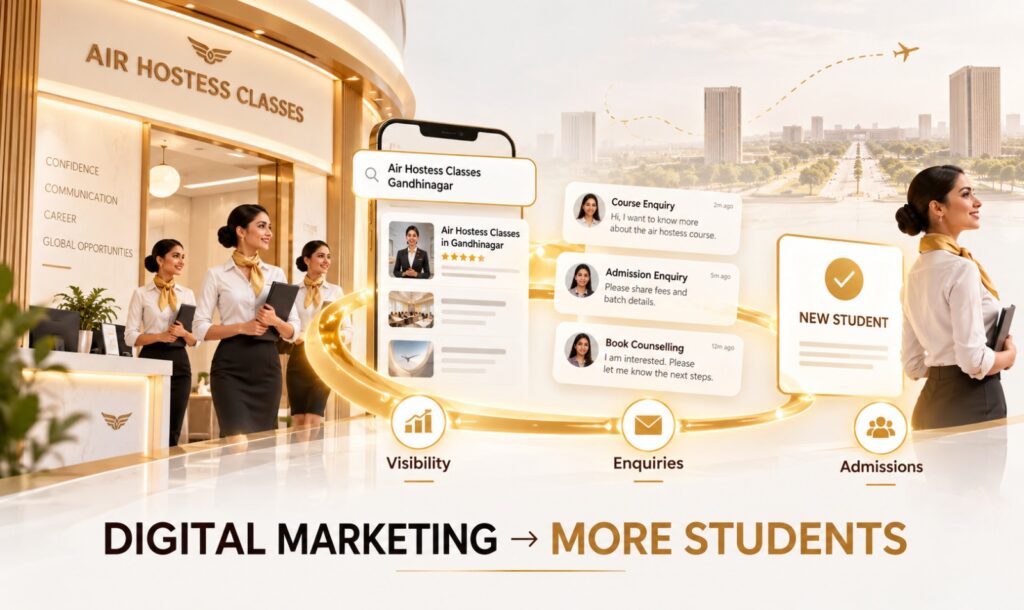
How Can Digital Marketing Help Air Hostess Classes in Gandhinagar Get More Students?
Digital marketing can help an air hostess institute reach prospective students at several stages of the admission journey, from initial course discovery to enquiry and final admission. The most important benefit is not simply online visibility; it is the ability to communicate the institute’s course, credibility and student experience to people who are actively considering aviation or hospitality training.
A student may begin with a broad search such as:
“Air hostess course after 12th”
Later, the search may become more specific:
“Air hostess training in Gandhinagar”
Then the student may compare:
“Air hostess institute fees Gandhinagar”
Finally, they may search for the name of a particular institute.
Each query reflects a different stage of intent.
A strong digital marketing strategy should therefore include:
Search visibility → useful information → institute evaluation → enquiry → counselling → admission
SEO can help the institute create pages around relevant course and location topics. Google Ads can provide paid visibility for searches where immediate enquiry generation is important. Instagram and Facebook can demonstrate the campus, trainers, classroom environment, grooming activities and student experiences. Short-form video can answer questions that are difficult to communicate through static text.
The website should then act as the central conversion point.
A strong course page can explain:
* Course name
* Eligibility
* Duration
* Curriculum
* Training modules
* Practical activities
* Communication training
* Grooming modules
* Faculty information
* Certification information where applicable
* Placement information where genuinely supported
* Fees or fee enquiry process
* Location
* Admission process
* Contact options
* Frequently asked questions
The information should be accurate and updated.
Digital marketing should also distinguish between marketing claims and verifiable facts. For example, an institute should not promise that every student will become cabin crew or guarantee airline placement unless such a claim can genuinely be supported under clearly stated terms.
Google’s current Search Essentials emphasise helpful, reliable, people-first content and prohibit manipulative practices.
The same principle applies to advertising.
An ad promising a guaranteed airline job may generate attention but can create trust and compliance problems if the institute cannot substantiate the claim. Google Ads policies also require advertisers to avoid misleading practices and meet editorial and technical standards.
The best digital strategy therefore makes the institute easier to discover, easier to evaluate and easier to contact.
Why Do Air Hostess Institutes Need Social Media Marketing in 2027?
Air hostess institutes need social media marketing because prospective students increasingly want to understand the experience behind an educational programme, not simply read a course name and fee.
A website can explain the curriculum, but social media can show what training actually looks like.
For an aviation-training institute, visual content can demonstrate:
* Grooming sessions
* Communication practice
* Mock interview preparation
* Personality-development activities
* Classroom training
* Hospitality training
* Aviation-related workshops
* Student activities
* Faculty introductions
* Campus environment
* Events
* Student achievements
This makes social media particularly relevant to courses where presentation, communication and practical training form part of the perceived value.
However, social media should not become an endless collection of glamorous photographs.
A student or parent may have serious questions:
Is the course suitable for me?
What are the eligibility requirements?
What exactly will I learn?
How long does training take?
Who teaches the course?
What happens after completing it?
Is placement support provided?
What does the admission process involve?
Content should answer those questions.
A useful 2027 social-media strategy can use several content pillars.
Educational content:
Explain aviation careers, eligibility, training and interview preparation.
Institute content:
Show classes, trainers, infrastructure and activities.
Student content:
Show genuine student experiences and milestones, with permission.
Career content:
Discuss possible aviation and hospitality career paths without guaranteeing employment.
FAQ content:
Answer common admission questions.
Conversion content:
Explain course enquiries, counselling sessions, open days or admission processes.
Instagram can be especially useful for visual discovery, while Facebook may continue to be relevant for parents, local communities and broader demographic groups. YouTube can provide longer educational explanations and institute tours.
The objective should not be to make every platform identical.
Instead, each channel should have a role within the wider admission funnel.
The institute should also avoid artificially manufacturing engagement. Buying followers or using misleading engagement tactics does not create a genuine student pipeline.
Google’s people-first guidance similarly recommends creating content because it is useful to an intended audience, rather than producing large amounts of content primarily to manipulate search visibility.
For an air hostess institute, social media should therefore answer one important question:
“Why should a prospective student trust this institute enough to enquire?”
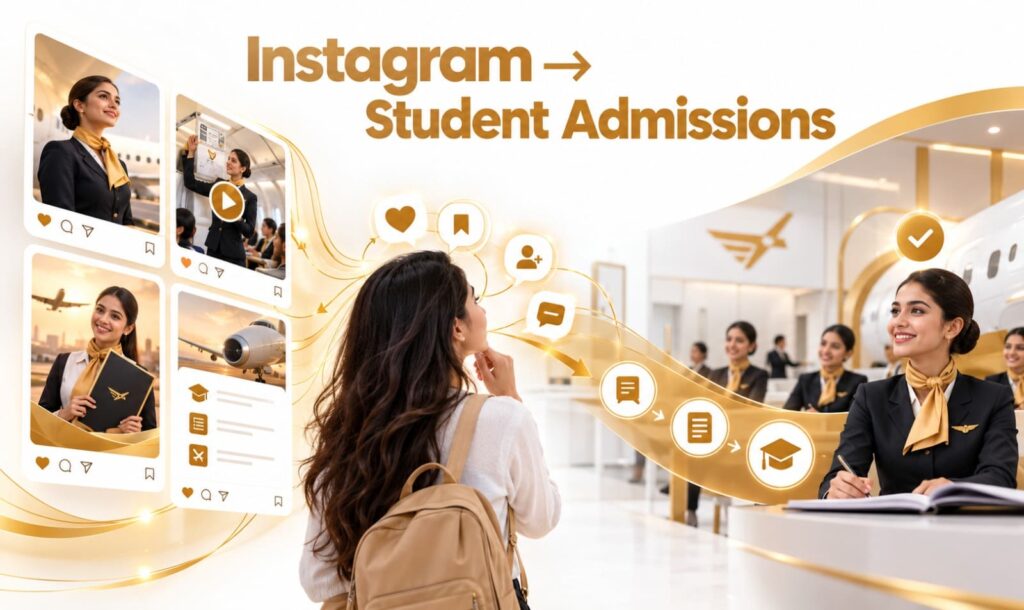
How Can Instagram Help Air Hostess Classes Attract More Students?
Instagram can help air hostess classes attract prospective students by combining visual storytelling, educational content, short-form video, student experiences and direct enquiry opportunities.
The platform should not be treated only as a photo gallery.
For an aviation-training institute, Instagram can demonstrate the actual learning environment.
For example, a Reel could show:
“A day inside our aviation training classroom.”
Another could explain:
“What happens during an air hostess grooming session?”
Another could answer:
“What should you prepare before an airline interview?”
Another could introduce:
“Meet the trainer who conducts our communication module.”
This creates a much stronger connection between the prospective student and the institute.
The Instagram profile itself also needs optimisation.
A potential student should be able to understand within seconds:
* What the institute offers
* Where it is located
* Who the course is for
* What major training areas are covered
* How to contact the institute
Pinned posts can be used strategically.
A useful three-post structure could be:
Post 1: About the institute
Explain the training centre, location and overall programme.
Post 2: Course information
Explain eligibility, duration, modules and admission process.
Post 3: Student experience
Show genuine classroom activity, testimonials or training sessions.
Reels can then drive people towards those pinned resources.
Instagram Stories can support daily engagement through:
* Polls
* FAQs
* Classroom clips
* Trainer Q&A
* Event announcements
* Admission reminders
* Student activities
The institute can also use a direct CTA:
“Send us ‘COURSE’ to receive the programme details.”
or:
“WhatsApp us to book a counselling session.”
However, the business should ensure that the response process behind the CTA is actually organised.
If an advertisement generates 100 enquiries but nobody responds promptly, the marketing investment may not produce corresponding admissions.
Instagram should also avoid unrealistic aviation imagery or misleading career promises. If the institute shows airline uniforms, aircraft or cabin-crew imagery, the content should not imply an affiliation with an airline unless that relationship genuinely exists.
The strongest Instagram presence is one that combines aspiration with information.
Students can be inspired by aviation careers, but they also need accurate information to make an education decision.
That combination makes Instagram a useful part of the admissions funnel rather than simply an awareness channel.
How Can Meta Ads Generate Student Leads for Air Hostess Institutes?
Meta Ads can generate student leads by placing course-related advertisements in front of defined audience segments and giving interested users a simple way to request information, contact the institute or visit a course landing page.
The important word is qualified.
A campaign that produces a large number of inexpensive form submissions is not automatically successful if most leads are irrelevant, unreachable or unwilling to pursue the course.
A better campaign begins with a clearly defined audience.
Potential targeting considerations can include:
* Geographic area
* Age range appropriate to the institute’s actual admissions requirements
* Relevant interests where available and appropriate
* Students or recent school/college audiences where appropriate
* Parents or decision-makers for suitable campaigns
* Retargeting audiences
* Website visitors
* Social-media engagers
Targeting should always comply with the platform’s current advertising policies and applicable law.
Different campaigns can have different objectives.
Awareness campaign
Introduce the institute and its training environment.
Lead-generation campaign
Offer course information, counselling or an enquiry form.
Retargeting campaign
Reach people who previously interacted with the institute but did not enquire.
Conversion campaign
Encourage qualified prospects to take a defined next step.
Creative matters significantly.
Instead of a generic graphic saying:
“Air Hostess Course — Admissions Open”
the institute could test creative themes such as:
“Thinking about a career in aviation after 12th?”
or:
“What do you actually learn in an air hostess training course?”
The landing experience should match the advertisement.
If an ad promises course details, the form or landing page should provide course details.
A lead form might ask for:
* Name
* Phone number
* Email
* Education level
* Preferred course
* City/area
* Preferred counselling time
The exact fields should be kept appropriate and not unnecessarily intrusive.
Lead forms should also have appropriate privacy information. Google, for example, requires privacy policies for eligible lead-form assets and has specific lead-form requirements.
For Meta campaigns, the institute should likewise follow Meta’s current advertising and data policies.
Most importantly, the agency should connect advertising with admissions data.
A useful funnel is:
Ad impression → Click/lead → Contacted → Qualified → Counselling → Application → Admission
This allows the institute to identify whether the problem is advertising or sales follow-up.
For example, if many leads are generated but very few attend counselling, the institute may need to improve lead qualification, communication or appointment reminders.
If counselling attendance is strong but applications remain low, the issue may lie elsewhere in the admission experience.
Meta Ads can therefore become powerful when treated as part of a complete acquisition system rather than simply a tool for increasing lead volume.
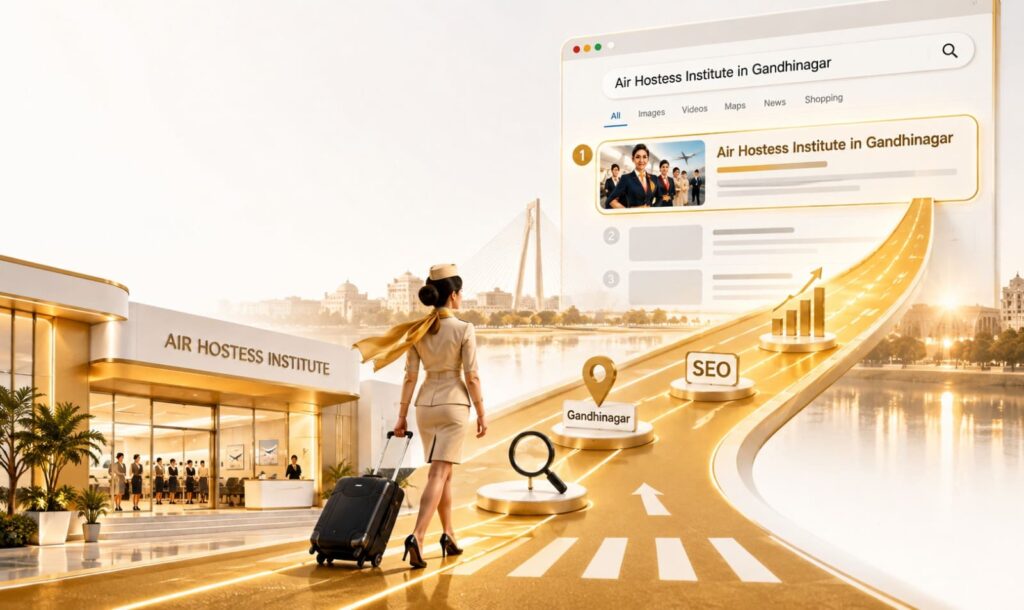
How Can SEO Help Air Hostess Institutes Rank on Google in Gandhinagar?
SEO can help an air hostess institute become more discoverable when prospective students search for aviation training information, courses, eligibility, fees, institutes, and related questions in Gandhinagar. By working with a provider offering SEO Services in Ahmedabad, an aviation institute can improve its search visibility, attract relevant prospective students, and build a stronger online presence among students actively looking for aviation and air hostess courses.
The foundation is understanding search intent.
Someone searching:
“air hostess course”
has a broad information need.
Someone searching:
“air hostess course after 12th”
has a more specific educational question.
Someone searching:
“air hostess institute Gandhinagar”
has local commercial intent.
Someone searching:
“air hostess course fees Gandhinagar”
is further along the decision process.
The website should therefore have useful pages addressing different intents instead of forcing every keyword onto one page.
Potential pages could include:
* Air Hostess Course in Gandhinagar
* Aviation Training Course
* Cabin Crew Training
* Course Eligibility
* Course Curriculum
* Course Duration
* Admission Process
* Career Options After Training
* Frequently Asked Questions
* Institute About Page
* Contact/Location Page
Each page should serve a distinct purpose.
Local SEO is also important.
The institute’s business details should be accurate and consistent across relevant platforms. Its Google Business Profile should contain accurate information, and the website should clearly communicate the physical location and services.
Technical SEO is equally important.
Google’s technical guidance states that pages need to be accessible to Googlebot, return a working HTTP status and contain indexable content to be eligible for indexing.
An agency should therefore audit:
* Crawlability
* Indexability
* Page speed
* Mobile usability
* Internal linking
* Canonicalisation
* Metadata
* Heading structure
* Structured data where appropriate
* Image optimisation
* HTTPS
* Broken links
* Redirects
* XML sitemap
Content quality matters just as much.
An institute should not create dozens of thin pages such as:
Air Hostess Course in Gandhinagar
Air Hostess Course Near Gandhinagar
Best Air Hostess Course Gandhinagar
Air Hostess Training Gandhinagar
if those pages provide essentially the same information.
Google specifically warns against creating content at scale primarily to manipulate search rankings or generative-search visibility.
The better strategy is to build a genuinely useful course resource that students and parents would want to bookmark.
What Should Air Hostess Institutes Look for in a Digital Marketing Agency?
An air hostess institute should evaluate a digital marketing agency based on its ability to understand the student acquisition and admission journey, not simply the number of services listed on its website.
The first question should be:
“How will you generate qualified student enquiries for our specific courses?”
A good agency should be able to explain the journey from audience research to admission.
Ask the agency to explain:
* How it will research student search behaviour
* Which audience segments it will target
* How it will approach SEO
* How it will structure Google Ads
* How it will use Meta Ads
* What social content it recommends
* How it will improve landing pages
* How it will track leads
* How it will measure admission quality
* How frequently it will report performance
Education marketing requires careful messaging because students may be making an important career decision.
The agency should therefore understand the difference between:
Generating attention
and
generating qualified education enquiries.
Ask for examples of relevant work if the agency has permission to disclose them.
Look for evidence such as:
* Relevant case studies
* Actual campaign examples
* Website improvements
* Content samples
* Lead-generation processes
* Reporting examples
* Client references where available
Do not accept unsupported claims such as:
“We guarantee Google #1.”
Google explicitly states that following Search Essentials does not guarantee that a page will be crawled, indexed or served in search results.
Similarly, an agency should not guarantee a fixed number of admissions from advertising without understanding the institute’s offer, sales process, competition, capacity and lead-handling process.
Pricing should also be evaluated carefully.
The institute should understand whether the quoted fee covers:
* Strategy
* Content
* Creative design
* Video production
* SEO
* Ads management
* Ad spend
* Landing pages
* Reporting
* Lead management
* Website changes
Agency fees and advertising budgets are usually separate considerations.
Finally, clarify ownership.
The institute should know who owns:
* Website
* Domain
* Ad accounts
* Analytics
* Search Console
* Social accounts
* Creative assets
* Lead data
A strong agency relationship should be transparent enough that the institute understands what is being done and why.
How Can Digital Marketing Increase Admissions for Air Hostess Courses?
Digital marketing can increase admissions when it improves the entire path between student discovery and admission, rather than focusing exclusively on traffic or lead volume.
The first step is awareness.
A prospective student discovers the institute through Google, Instagram, Facebook, YouTube, a recommendation or an advertisement.
Next comes consideration.
The student investigates:
* Course content
* Eligibility
* Duration
* Fees
* Location
* Training environment
* Faculty
* Career relevance
* Student experiences
* Admission process
The website and social profiles should answer these questions clearly.
Next comes enquiry.
This could happen through:
* WhatsApp
* Phone
* Lead form
* Website form
* Instagram DM
* Counselling booking
The institute then needs a structured counselling process.
A useful admission funnel could be:
Lead → Contacted → Qualified → Counselling booked → Counselling attended → Application → Admission
Digital marketing can influence several stages, but it cannot replace the institute’s actual sales and counselling process.
For example, suppose an agency generates a high number of enquiries. If the admissions team takes too long to respond, does not understand the course, or provides inconsistent information, the marketing investment may not translate into admissions.
Therefore, marketing and admissions teams need to work together.
The agency should ideally receive feedback about:
* Which leads were genuine
* Which courses generated interest
* Common objections
* Why prospects did not enrol
* Which geographic areas produced useful leads
* Which campaigns generated better students
* Which questions repeatedly appear during counselling
That information can then improve campaigns.
If students repeatedly ask about eligibility, create an eligibility page and social content.
If students are confused about course duration, create a clear course-duration explanation.
If parents ask about placement support, create a transparent explanation of what the institute actually provides.
This creates a feedback loop:
Marketing data → Admissions feedback → Better content → Better targeting → Better lead qualification → Better admissions
The institute should measure more than clicks.
Useful business metrics include:
* Qualified enquiries
* Counselling bookings
* Counselling attendance
* Applications
* Admissions
* Cost per qualified lead
* Cost per application
* Cost per admission
The exact financial metrics will depend on the institute’s fees, margins and internal accounting.
Digital marketing should therefore be treated as an admission-support system, not a standalone promotional activity.
How Can Air Hostess Training Institutes Reach Local Students in Gandhinagar?
Air hostess training institutes can reach local students in Gandhinagar by combining local SEO, social media, paid advertising, educational content and community-focused digital communication.
The first step is understanding the geographic audience.
Depending on the institute’s actual admissions area, potential students may come from Gandhinagar itself as well as nearby parts of Gujarat. The agency should determine the practical service and student catchment area rather than simply targeting a large radius without analysis.
Local SEO can support students who actively search for training options.
The website should clearly communicate:
* Institute location
* Course availability
* Contact information
* Directions
* Training facilities
* Course details
* Admission process
The Google Business Profile should also be kept accurate.
Social media can complement local discovery by showing the institute’s actual environment.
For example:
“Inside our aviation training classroom in Gandhinagar”
can demonstrate the physical experience much more effectively than a generic stock photograph.
Local content can also involve:
* Student events
* Workshops
* Open days
* Seminars
* Career sessions
* Campus activities
* Faculty introductions
* Local educational collaborations
The institute can also create content specifically designed for parents.
Parents may be involved in education decisions and may have different questions from students.
Student-focused content might discuss:
* Career exploration
* Training
* Interview preparation
* Grooming
* Communication
Parent-focused content may explain:
* Course structure
* Institute environment
* Fees
* Duration
* Admission process
* Training support
* Career information
This does not mean assuming that every student has the same decision-maker. The purpose is to recognise that education purchases can involve multiple stakeholders.
Google Search Ads can target relevant high-intent searches, while Meta campaigns can help introduce the institute to suitable audiences and retarget previous interactions.
Google’s lead-form documentation explains that lead forms allow users to submit information directly in response to an advertisement, subject to eligibility and policy requirements.
The institute should also make sure its contact process is reliable.
If a student clicks an advertisement at 10 AM and receives a response much later without useful information, the lead may have already contacted another institute.
Local marketing therefore requires more than local targeting.
It requires local relevance, useful information, visible trust signals and fast, organised follow-up.
How Can Reels and Short Videos Promote Air Hostess Courses Online?
Reels and short videos can promote air hostess courses by showing prospective students what training looks like, answering career questions and making the institute’s educational experience visible before the student visits.
The strongest videos are not necessarily the most glamorous ones.
A short video explaining:
“What happens in your first week of aviation training?”
may be more useful to a serious prospective student than a generic video showing a student walking through an airport.
Useful short-video topics include:
* What happens in an air hostess training course?
* What is taught during grooming sessions?
* How does communication training work?
* What happens during a mock interview?
* How can students prepare for airline interviews?
* What does a typical classroom session look like?
* Meet our aviation trainer
* 5 questions students ask before joining
* What should students know before choosing an institute?
* Course eligibility explained
* Course duration explained
* Student classroom experience
* Institute tour
* Frequently asked admission questions
A useful short-video structure is:
Hook → Information → Proof → CTA
For example:
Hook:
“Thinking about joining an air hostess course after 12th?”
Information:
“Here are three things you should check before selecting an institute.”
Proof:
Show the actual classroom, trainer or training process.
CTA:
“Contact our admissions team for the current course details.”
The CTA should match the content.
An educational Reel may direct users to a detailed course page.
A course-information Reel may direct them to WhatsApp.
An institute-tour Reel may invite them to book a visit.
Video quality should be professional enough to represent the institute accurately, but production does not need to become unnecessarily complicated.
Good lighting, clear audio, appropriate framing and useful information can be more important than elaborate effects.
The institute should also avoid using airline logos, uniforms or aircraft imagery in a way that could falsely imply an official airline relationship.
Similarly, videos should not promise:
“Guaranteed airline job after this course.”
unless the institute has a genuinely verifiable programme and can substantiate exactly what that statement means.
Short-form video can also support SEO when useful video content is embedded or presented on relevant website pages. Google recommends supporting textual content with high-quality, relevant images and videos when appropriate for generative search experiences.
The long-term value of Reels is therefore not just views.
It is the ability to repeatedly answer questions, demonstrate the institute’s actual environment and create familiarity with prospective students before they submit an enquiry.
How Can Air Hostess Institutes Convert Online Enquiries Into Admissions?
Converting online enquiries into admissions requires the institute to treat lead generation and counselling as connected processes. Digital marketing can create the opportunity, but the admissions team must then provide accurate information, respond promptly and help the prospective student understand whether the course is appropriate for them.
The first step is lead qualification.
An enquiry form or counsellor may need to understand:
* Student name
* Contact details
* Education level
* Age or eligibility information where legitimately required
* Preferred course
* Location
* Preferred counselling time
* Main questions or concerns
The exact data collected should be appropriate, transparent and handled responsibly.
After receiving an enquiry, the institute should have a consistent response process.
For example:
Step 1: Acknowledge the enquiry
Confirm that the institute has received the request.
Step 2: Understand the requirement
Ask what the student wants to know.
Step 3: Provide accurate course information
Explain eligibility, duration, curriculum, fees and admission details.
Step 4: Offer counselling
Where appropriate, schedule a call or meeting.
Step 5: Follow up
Send relevant information and reminders.
Step 6: Track the outcome
Record whether the student:
* Did not respond
* Was not eligible
* Was only researching
* Attended counselling
* Applied
* Enrolled
This data is extremely valuable for marketing.
Suppose Instagram produces many enquiries but very few admissions.
That does not automatically mean Instagram is ineffective.
The problem could be:
* Poor lead quality
* Weak follow-up
* Unclear course information
* Pricing mismatch
* Slow response
* Poor counselling experience
* Incorrect audience targeting
Similarly, Google Search might generate fewer enquiries but a larger proportion of high-intent prospects.
Without tracking the complete funnel, the institute cannot know.
A useful reporting structure is:
Stage Metric
Awareness Reach/impressions
Interest Website/profile visits
Lead Enquiries
Qualification Qualified leads
Counselling Bookings
Engagement Attendance
Application Applications
Admission Enrolments
Commercial Revenue
The agency and admissions team should review these numbers together.
Student privacy should also be taken seriously. Advertising and lead-collection platforms have policies around customer information and data handling. Google, for example, publishes specific customer-data and lead-form requirements for advertisers.
The ultimate objective is not to pressure every enquiry into enrolling.
It is to help suitable students understand the programme and make an informed decision.
A trustworthy admissions process can therefore become a competitive advantage in itself.
How Much Should an Air Hostess Institute Spend on Digital Marketing?
There is no single responsible marketing budget that applies to every air hostess institute because the appropriate investment depends on course fees, admission capacity, geography, competition, existing brand awareness, website quality, sales capacity and business objectives.
Instead of starting with an arbitrary number, the institute should build its budget around the admission funnel.
The budget can be divided into different components:
Agency or strategy fee
Payment for planning, management, optimisation and reporting.
Advertising spend
Budget paid to Google, Meta or other advertising platforms.
Content production
Photography, Reels, videos, graphics and editing.
Website and landing pages
Development or optimisation of pages used for SEO and paid campaigns.
SEO
Technical optimisation, content, local SEO and authority-building activities.
CRM or lead management
Tools used to record and manage enquiries.
Creative testing
Different advertisements, hooks, offers and landing-page messages.
These should not automatically be combined into one vague monthly fee.
An institute should ask an agency:
“Exactly what is included in the monthly fee, and what is paid separately?”
It should also ask:
“How much of our budget is going toward advertising versus management and content?”
This is particularly important for paid campaigns.
An agency might charge a management fee while the institute pays advertising platforms directly. That structure can make reporting clearer.
The budget should then be connected to measurable stages.
For example:
Marketing spend → leads → qualified leads → counselling → applications → admissions
If the institute knows its acceptable acquisition economics, it can make better decisions.
The agency should not promise:
“Spend ₹X and get exactly Y students.”
There are too many variables involved, including competition, audience demand, course positioning, admissions capacity and sales follow-up.
Google also makes clear that advertising platforms operate under policies and that advertisers must comply with applicable requirements.
A sensible approach is to start with a test period, establish baseline performance, identify which campaigns and audiences generate useful leads, and then scale what is demonstrably working.
The institute should also maintain enough budget for experimentation.
If every rupee is allocated to one advertisement and nothing is tested, the business may never discover which messaging works better.
The objective should be controlled learning followed by informed scaling, not spending the maximum possible amount.
What Should the 2027 Digital Marketing Strategy for an Air Hostess Institute in Gandhinagar Look Like?
A strong 2027 strategy should combine organic search, paid acquisition, social media, video, website optimisation and admissions follow-up rather than depending on one marketing channel.
The strategy can be organised into six interconnected areas.
Search visibility
Build useful pages around:
* Air hostess courses
* Cabin crew training
* Aviation training
* Eligibility
* Course duration
* Curriculum
* Fees
* Admission process
* Gandhinagar-related local intent
The objective is to become useful for both informational and commercial searches.
Social media
Build consistent Instagram, Facebook and video content around:
* Student questions
* Training activities
* Trainer expertise
* Institute experience
* Course education
* Genuine student stories
* Admissions information
Paid acquisition
Use Google Ads for relevant high-intent searches and Meta campaigns for audience discovery, lead generation and retargeting.
Conversion optimisation
Create landing pages that answer:
What is the course?
Who is eligible?
What is included?
Where is the institute?
Why consider this institute?
How do I enquire?
Lead management
Every enquiry should enter a trackable system.
The institute should know:
Where did this lead come from?
Was it qualified?
Did counselling happen?
Did the student apply?
Did the student enrol?
Continuous optimisation
Every month, review:
* Search performance
* Paid campaign performance
* Lead quality
* Counselling attendance
* Applications
* Admissions
* Content engagement
* Website conversion
* Common student objections
This creates a feedback loop between marketing and admissions.
The strategy should also remain flexible because digital platforms, advertising features, search behaviour and audience behaviour can change.
Google’s current AI-search guidance specifically warns against creating large amounts of near-duplicate content simply to capture variations of queries or manipulate AI-generated search experiences. Instead, Google recommends focusing on what visitors actually need and creating satisfying, useful content.
That is particularly relevant for an education institute.
Instead of creating 50 pages targeting slightly different versions of:
“air hostess course Gandhinagar”
the institute should create a smaller number of substantially useful pages covering the actual questions students and parents have.
The result should be a digital presence that is:
Discoverable → Informative → Trustworthy → Local → Conversion-focused → Measurable.
That is a much stronger foundation for 2027 than simply increasing the number of posts or advertisements.
What Are the Biggest Digital Marketing Mistakes Air Hostess Institutes Should Avoid?
Air hostess institutes should avoid digital marketing practices that generate attention without building trust or qualified student demand.
The first major mistake is making employment guarantees that cannot be substantiated. Statements such as “100% airline placement” or “guaranteed cabin crew job” should only be used when the exact claim can genuinely be supported and its terms are transparent.
The second mistake is using airline branding in a misleading way. An institute should not imply that it is officially affiliated with an airline unless such an affiliation actually exists.
The third mistake is buying followers.
A large Instagram audience does not necessarily create admissions. The institute needs relevant students and genuine engagement.
The fourth mistake is running advertisements without tracking admissions.
If the only metric is the number of leads, the institute may optimise toward cheap enquiries instead of suitable applicants.
The fifth mistake is sending all traffic to the homepage.
Someone clicking an ad about an air hostess course should ideally reach a relevant course page or landing page that answers their specific questions.
The sixth mistake is creating thin SEO pages.
Google’s current guidance specifically encourages comprehensive, helpful content and warns against content created primarily to manipulate search rankings.
The seventh mistake is publishing generic social media content.
If every post is a stock photo of a flight attendant with motivational text, the institute does not demonstrate its actual educational experience.
The eighth mistake is ignoring parents’ questions.
Depending on the audience and institute, parents may want detailed information about the course, costs, training environment and career pathway.
The ninth mistake is slow lead follow-up.
A student contacting three institutes may naturally continue with the one that provides useful information quickly.
The tenth mistake is choosing an agency based only on the word “best.”
A digital marketing agency should be evaluated against the institute’s actual requirements.
Ask:
* Can they manage student lead generation?
* Can they handle education-focused SEO?
* Can they create Reels?
* Can they manage Meta Ads?
* Can they manage Google Ads?
* Can they build landing pages?
* Can they track admissions?
* Can they provide transparent reporting?
The goal should be a measurable acquisition system rather than impressive marketing terminology.
How Should an Air Hostess Institute Choose Between Digital Marketing Agencies in Gandhinagar?
The final agency decision should be based on strategic fit, relevant capabilities, transparency, communication and measurable business objectives, rather than simply choosing the agency with the strongest marketing language.
Start by preparing a brief.
The brief should contain:
* Institute location
* Courses offered
* Eligibility requirements
* Target student audience
* Target geographic area
* Current student intake
* Admission goals
* Current website
* Current social profiles
* Existing advertising accounts
* Monthly marketing budget
* Previous campaign performance
* Major competitors
* Key differentiators
Then ask each shortlisted agency to respond to the same requirements.
This makes comparisons more meaningful.
Ask each agency to explain:
1. SEO strategy
Which pages would they build or improve?
2. Google Ads strategy
Which types of search intent would they target?
3. Meta Ads strategy
How would they approach awareness, lead generation and retargeting?
4. Social media strategy
What content pillars would they recommend?
5. Landing-page strategy
Where would paid traffic go?
6. Lead management
How would enquiries be tracked?
7. Reporting
Which metrics would be reported every month?
8. Optimisation
How would campaigns change based on actual admission data?
The institute should also ask to see examples of previous work where disclosure is permitted.
Look for evidence rather than promises.
A useful proposal should explain:
Problem → Audience → Strategy → Execution → Measurement → Optimisation
rather than simply listing:
SEO + SMM + Google Ads + Website + Branding.
The latest Gandhinagar agency landscape demonstrates that many agencies offer overlapping services, including SEO, social media, PPC, web development and content.
That makes differentiation between agencies more difficult.
Therefore, the institute should evaluate how the agency intends to apply those services to aviation education.
For example, a technically strong SEO agency may not necessarily be the strongest choice for a visually driven student-acquisition campaign.
Likewise, a creative social-media agency may not necessarily have the technical SEO or lead-tracking capability required for a complete admissions funnel.
The ideal agency depends on the institute’s needs.
Finally, clarify ownership and access.
The institute should retain appropriate administrative ownership or access to important digital assets such as:
* Domain
* Website
* Google Business Profile
* Google Analytics
* Search Console
* Google Ads
* Meta Business Manager
* Instagram
* Facebook
* Creative files
* Lead records
This reduces operational dependency and makes future agency transitions easier.
A good agency relationship should feel like a transparent growth partnership, not a black box.
How Can an Air Hostess Institute Measure Whether Its Digital Marketing Agency Is Working?
The institute should measure agency performance through business outcomes and meaningful marketing indicators, not through rankings or social-media numbers alone.
A useful reporting framework begins at the top of the funnel.
Visibility
Track:
* Search impressions
* Organic clicks
* Social reach
* Video views
* Website traffic
* Profile visits
These indicate whether the marketing is creating exposure.
Engagement
Track:
* Content interactions
* Website engagement
* Video retention where available
* Enquiries
* Landing-page engagement
These show whether the audience is taking interest.
Lead generation
Track:
* Total enquiries
* Qualified enquiries
* Cost per lead
* Cost per qualified lead
* Lead source
Admission funnel
Track:
* Counselling bookings
* Counselling attendance
* Applications
* Admissions
* Cost per application
* Cost per admission
This is where marketing becomes connected to business results.
For example:
Stage Metric
Search/social visibility Impressions/reach
Website interest Visits
Enquiry Leads
Qualification Qualified leads
Counselling Bookings
Attendance Completed counselling
Application Applications
Admission Enrolments
Commercial outcome Revenue
The agency should be able to explain changes in these numbers.
If organic traffic rises but enquiries do not, investigate whether the traffic is relevant.
If Meta leads rise but qualified leads fall, investigate audience targeting and creative.
If Google Ads generate highly relevant leads but cost more, compare the actual cost per admission rather than automatically selecting the campaign with the cheapest lead.
If social media engagement falls but admissions increase, the business should not necessarily panic.
Marketing metrics need context.
Google’s own guidance makes clear that SEO does not provide guaranteed rankings or guaranteed indexing.
Therefore, agencies should avoid presenting rankings as guaranteed outcomes.
The institute should also conduct periodic reviews.
A useful quarterly review can ask:
* Which channels generated admissions?
* Which campaigns generated qualified students?
* Which course pages attracted search traffic?
* Which student questions appeared repeatedly?
* Which advertisements should be stopped?
* Which content should be expanded?
* Which audiences should be tested?
* Which landing pages need improvement?
This makes digital marketing an ongoing learning process.
The best reporting system is not the one with the largest number of charts.
It is the one that allows the institute’s management team to answer:
“What did we spend, what did we learn, how many qualified opportunities did we create, and what ultimately contributed to admissions?”
Conclusion:- Choosing a Digital Marketing Agency for Air Hostess Classes in Gandhinagar in 2027
The right digital marketing strategy for an air hostess institute should be built around the student journey rather than around individual platforms.
Students may discover an institute through Instagram, search Google for course information, compare websites, watch Reels, check reviews, speak with counsellors and then decide whether to apply.
That means an institute’s digital presence needs to work as one connected system:
SEO → Google Search → Website → Instagram → Meta Ads → WhatsApp → Counselling → Application → Admission
The 12 agencies discussed in this guide represent examples from the current Gandhinagar digital-marketing landscape available in September 2026. The list should be treated as a starting point for research rather than a permanent 2027 ranking. GoodFirms’ current Gandhinagar directory itself is subject to change and currently lists 30 verified agencies.
For an air hostess institute, the most important selection criteria should therefore be:
Relevant experience → Student-focused strategy → SEO capability → Meta Ads → Google Ads → Content creation → Landing pages → Lead tracking → Transparent reporting → Admission-focused optimisation
An agency does not need to provide every imaginable digital service.
It needs to provide the right combination for the institute’s actual growth objectives.
The institute should also avoid unrealistic expectations.
SEO cannot guarantee a particular Google position. Advertising cannot guarantee a fixed number of admissions. Social media cannot guarantee that every follower will become a student.
What digital marketing can provide is a structured system for improving discovery, communication, lead generation and measurement.
Google’s current Search Essentials recommend helpful, reliable, people-first content and explicitly caution that meeting technical and best-practice requirements does not guarantee crawling, indexing or search visibility.
For 2027, an air hostess institute in Gandhinagar should therefore focus on building a digital presence that answers the questions prospective students actually have.
What is the course?
Who is eligible?
What will I learn?
Where is the institute?
What does the training experience look like?
What support does the institute actually provide?
How do I enquire?
What happens after I submit my enquiry?
When these questions are answered clearly across search, social media, advertising and the website, digital marketing becomes more than promotion.
It becomes part of the institute’s student-acquisition and admission process.

Frequently Asked Question
Digital marketing can help air hostess institutes reach prospective students through SEO, Google Ads, Instagram, Facebook, YouTube, content marketing and lead-generation campaigns. A well-planned strategy can increase relevant website traffic, generate enquiries and support the admission process.
Choose an agency based on its experience, digital marketing capabilities, understanding of education marketing, lead-generation strategy, reporting process and ability to track enquiries through admissions. Ask agencies about their approach to SEO, Google Ads, Meta Ads, social media and conversion optimisation.
Important services can include SEO, local SEO, Google Ads, Meta Ads, social media marketing, content creation, video marketing, website development, landing-page optimisation and lead tracking. The right combination depends on the institute’s audience, courses and admission goals.
SEO can improve an institute’s visibility for relevant searches such as air hostess courses, cabin crew training, course eligibility, fees and aviation institutes in Gandhinagar. Optimising useful course pages, local information, technical SEO and relevant content can help search engines understand the institute and its services.
Google Ads can place an institute in front of people searching for relevant courses and training programmes. Search campaigns can direct prospective students to dedicated landing pages where they can view course information and submit an enquiry or contact the institute.
Instagram can attract prospective students through Reels, trainer introductions, classroom videos, grooming-session content, institute tours, FAQs, student experiences and educational aviation content. Clear profile information and calls to action can then encourage interested users to enquire.
Meta Ads can help institutes reach relevant audiences through Facebook and Instagram campaigns. Lead forms, WhatsApp campaigns, website traffic campaigns and retargeting can be used to encourage prospective students to request course information or counselling.
The institute should have a structured process for responding to enquiries, qualifying prospective students, providing accurate course information, scheduling counselling and following up. Tracking each lead from its original marketing source through counselling, application and admission can help identify where improvements are needed.
There is no fixed digital marketing budget that suits every institute. The appropriate amount depends on course fees, admission targets, competition, geographic market, advertising objectives, existing brand awareness and available marketing resources. Agency fees, advertising spend, content production and website costs should be considered separately.
Measure the complete funnel rather than only followers, clicks or impressions. Important metrics can include qualified enquiries, cost per lead, counselling bookings, counselling attendance, applications, admissions, cost per admission and revenue generated from marketing campaigns.
Ask about their experience with education marketing, SEO strategy, Google Ads, Meta Ads, content creation, landing pages, lead tracking, reporting and conversion optimisation. Also clarify pricing, deliverables, advertising budgets, ownership of digital accounts and how campaign performance will be measured against actual admissions.