
Digital Marketing for Metal & Steel industry is essential for an industry that is highly competitive, specification-driven, and built on long-term B2B relationships. Manufacturers, suppliers, fabricators, processors, exporters, and industrial distributors have traditionally generated business through referrals, sales representatives, trade exhibitions, distributors, and established customer networks. While these channels remain important, the B2B buying process is increasingly supported by digital research. Partnering with a Digital Marketing Agency in Ahmedabad can help metal and steel businesses strengthen their online presence, reach relevant industrial buyers, showcase their products and capabilities, and generate qualified B2B enquiries.
Before contacting a supplier, a procurement manager may search for a specific material, grade, product, manufacturing capability, application or supplier. An engineer may research technical specifications. An OEM may compare manufacturers. An importer may investigate exporters in a particular country. A contractor may search for a fabrication partner in a particular region.
This creates a major opportunity for companies that use [digital marketing] to make their products, capabilities and technical information easy to discover online.
However, digital marketing for the metal and steel industry is not simply about getting more website visitors. The commercial objective is to attract relevant industrial buyers, demonstrate capability, establish credibility and convert qualified visitors into enquiries, RFQs and sales opportunities.
A practical B2B digital marketing journey can therefore be represented as:
Search → Product/Specification → Capability → Proof → Trust → RFQ → Sales Qualification
This guide explains how metal and steel companies can use SEO, Google Ads, content marketing, LinkedIn, website optimisation, local SEO, international marketing and AI-search-friendly content to build a stronger B2B lead-generation system.
Digital Marketing for the Metal and Steel Industry: Strategies to Generate B2B Leads
The metal and steel industry is highly competitive, specification-driven and dependent on long-term B2B relationships. Manufacturers, suppliers, fabricators, processors, exporters and industrial distributors have traditionally generated business through referrals, sales representatives, trade exhibitions, distributors and established customer networks. These channels remain important, but the B2B buying process is increasingly supported by digital research.
Before contacting a supplier, a procurement manager may search for a specific material, grade, product, manufacturing capability, application or supplier. An engineer may research technical specifications. An OEM may compare manufacturers. An importer may investigate exporters in a particular country. A contractor may search for a fabrication partner in a particular region.
This creates a major opportunity for companies that can make their products, capabilities and technical information easy to discover online.
However, digital marketing for the metal and steel industry is not simply about getting more website visitors. The commercial objective is to attract relevant industrial buyers, demonstrate capability, establish credibility and convert qualified visitors into enquiries, RFQs and sales opportunities.
A practical B2B digital marketing journey can therefore be represented as:
Search → Product/Specification → Capability → Proof → Trust → RFQ → Sales Qualification
This guide explains how metal and steel companies can use SEO, Google Ads, content marketing, LinkedIn, website optimisation, local SEO, international marketing and AI-search-friendly content to build a stronger B2B lead-generation system.

What Is Digital Marketing for the Metal and Steel Industry?
Digital marketing for the metal and steel industry refers to the use of online channels, platforms and content to help manufacturers, suppliers, fabricators, processors, exporters and other industrial businesses attract potential customers and generate commercial enquiries.
Unlike many consumer industries, metal and steel marketing often involves highly specific buying requirements. A prospect may not simply search for “steel.” They may search for a particular product, grade, dimension, manufacturing process, application, quantity, certification or geographical location.
For example, a buyer could search for:
* Stainless steel sheet manufacturer
* SS 304 supplier
* Carbon steel plate manufacturer
* Structural steel fabrication company
* Steel pipe supplier in India
* Metal fabrication company in Gujarat
* Bulk steel supplier
* Steel exporter
* Custom metal component manufacturer
* Industrial steel supplier
Each search represents a different combination of product intent, commercial intent, technical intent and location intent.
This is why industrial digital marketing needs to be more specific than a generic marketing strategy.
A strong strategy connects the company’s actual capabilities with the language used by potential buyers. If a manufacturer supplies stainless steel sheets in specific grades and thicknesses, its website should communicate those capabilities clearly. If a fabrication company specialises in structural steel, its website should explain its fabrication processes, project experience, equipment and applications.
The ultimate objective is to create a digital environment where a potential customer can answer five questions quickly:
1. Do you supply what I need?
2. Can you meet my technical requirements?
3. Do you have relevant experience?
4. Can I trust your company?
5. How can I request a quotation or discuss my requirement?
That is where digital marketing becomes a sales-enablement system rather than simply a traffic-generation activity.
Why Is Digital Marketing Important for Metal and Steel Companies?
The buying journey for industrial products can involve multiple people and multiple research stages. A procurement manager may initially discover a supplier through Google, while an engineer evaluates its technical information and a management team later reviews commercial terms.
This means a company can lose a potential customer long before the sales team knows that the opportunity existed.
A strong digital presence helps reduce this gap.
For example, imagine an engineering company needs a particular steel product. Its procurement employee searches Google, visits several supplier websites and compares their product information. One company has a detailed product page containing specifications, applications, certifications, manufacturing information and an RFQ form. Another company has only a homepage saying “We are a leading steel manufacturer.”
Even if both companies have comparable physical capabilities, the first website gives the buyer substantially more information for evaluation.
Digital marketing can therefore support metal and steel companies in several ways.
1. Increase product visibility
SEO can help relevant product and capability pages become discoverable for searches related to what the business actually sells.
2. Reach new geographical markets
A manufacturer can use search, paid advertising and international content to reach customers beyond its existing sales network.
3. Demonstrate technical expertise
Detailed product pages, technical articles and application guides can answer questions before a buyer contacts sales.
4. Support sales teams
A prospect who has already read about products, capabilities and certifications may enter the sales conversation with a clearer understanding of the company.
5. Generate measurable enquiries
Website forms, calls, RFQs and tracked campaigns provide measurable signals that can be connected to marketing activities.
The important point is that traffic should not be the only KPI. For a B2B manufacturer, ten highly relevant procurement enquiries can be more commercially meaningful than hundreds of visitors who have no intention of buying.

How Do B2B Buyers Search for Metal and Steel Suppliers?
One of the most important parts of an industrial SEO strategy is understanding that different buyers describe the same commercial requirement in different ways.
An engineer might search according to a technical specification. A procurement manager might search according to supplier type. An owner might search according to location. An export buyer might search according to country and product.
This creates several distinct search-intent categories.
Search intent Example Recommended content
Product stainless steel sheet supplier Product page
Manufacturer steel pipe manufacturer Manufacturer/product page
Specification SS 304 sheet supplier Grade/specification page
Capability structural steel fabrication Service page
Application steel for industrial construction Application page
Location steel supplier Gujarat Location/product page
Export steel exporter India Export page
Commercial bulk steel supplier Commercial landing page
Transactional steel supplier quotation RFQ landing page
Informational SS 304 vs SS 316 Educational article
This classification should influence the website architecture.
For example, a company should not expect one generic “Steel Products” page to rank effectively for every product, grade, application and commercial search.
A better architecture might be:
Steel Products
→ Stainless Steel
→ Stainless Steel Sheets
→ SS 304 Sheets
→ SS 316 Sheets
The exact hierarchy should depend on the actual catalogue. There is no benefit in creating pages for products the business does not supply.
Search intent should also influence content depth.
A person searching “what is stainless steel” needs educational information.
A person searching “SS 304 sheet supplier” needs commercial and technical information.
A person searching “SS 304 sheet quotation” is much closer to a conversion action.
Understanding these distinctions helps prevent a common SEO mistake: creating content around keywords without understanding why the searcher used them.
How to Build an SEO Strategy for the Metal and Steel Industry
A well-planned SEO strategy can become one of the most valuable long-term acquisition channels for industrial companies because it helps businesses appear when potential buyers are actively researching products, specifications, manufacturers, and suppliers. By investing in SEO Services in Ahmedabad, industrial businesses can improve their search visibility, reach relevant B2B buyers, attract qualified website traffic, and create more opportunities for long-term business enquiries.
However, industrial SEO should begin with the company’s product and capability catalogue, not with a random keyword list.
Start by documenting:
* Products
* Materials
* Grades
* Sizes
* Dimensions
* Manufacturing processes
* Fabrication capabilities
* Industries served
* Applications
* Certifications
* Service locations
* Export markets
* Buyer types
Once this information is documented, keywords can be mapped to the appropriate pages.
Product keywords
Examples include:
* steel pipe manufacturer
* stainless steel sheet supplier
* structural steel supplier
* carbon steel plate manufacturer
* steel coil supplier
Capability keywords
Examples include:
* structural steel fabrication
* custom metal fabrication
* CNC metal fabrication
* steel cutting services
* industrial welding services
Specification keywords
Examples include:
* SS 304 supplier
* SS 316 manufacturer
* carbon steel plate supplier
* mild steel pipe manufacturer
Commercial keywords
Examples include:
* bulk steel supplier
* industrial steel supplier
* steel exporter
* steel manufacturer
* metal supplier
Location keywords
Examples include:
* steel manufacturer in Gujarat
* steel supplier in Ahmedabad
* metal manufacturer in India
The key principle is keyword-to-page relevance.
A keyword should have a logical destination. If a company targets “SS 304 sheet supplier,” the user should land on a page specifically explaining SS 304 sheet availability rather than being redirected to a generic homepage.
Keyword density should not determine the quality of the page. Google’s documentation emphasises creating useful, reliable, people-first content rather than content designed primarily to manipulate rankings. The objective should therefore be to cover the subject naturally and comprehensively rather than repeatedly inserting the exact keyword.
How to Create High-Converting Product Pages for Steel and Metal Products
Product pages are among the most commercially important assets on an industrial website.
A weak product page might contain only the product name, a stock photograph, two paragraphs and a “Contact Us” button.
That creates a major information gap.
A procurement professional or engineer may need to know whether the supplier actually supports the required specification before making contact.
A stronger product page can include:
* Product overview
* Material
* Available grades
* Dimensions
* Thickness
* Size range
* Manufacturing process
* Surface finish
* Applications
* Industries served
* Technical standards
* Testing information
* Certifications
* Packaging
* Delivery regions
* Relevant documentation
* FAQs
* RFQ form
The exact information should reflect what the company genuinely provides.
Product pages should answer buyer questions
Imagine a buyer searching for stainless steel sheets.
The page should help answer:
What is the product?
Explain it clearly without unnecessary marketing language.
Which grades are available?
Only list grades the company actually supplies.
What sizes or thicknesses are available?
Provide accurate ranges where the business can substantiate them.
Where is the product used?
Explain relevant applications.
What standards or certifications apply?
Mention genuine standards and certifications.
How can the buyer request pricing?
Provide a clear RFQ path.
Add technical information as readable content
Important specifications should not exist exclusively inside an image.
If the information is commercially important, wherever appropriate it should be available as crawlable, readable website content.
This creates a useful connection between SEO and sales:
The information that helps search engines understand the page is often the same information that helps a technical buyer evaluate the supplier.
How Technical Content Can Generate Better B2B Leads
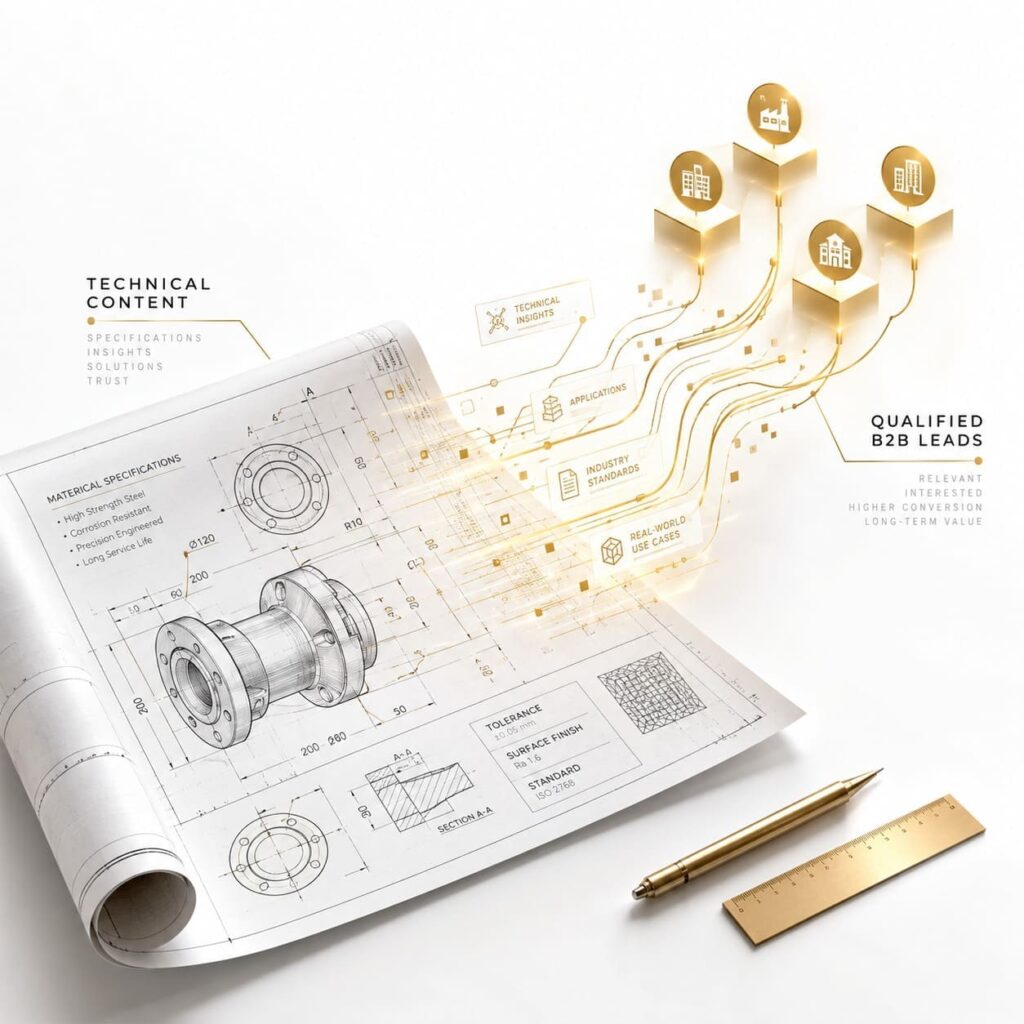
Technical content is particularly valuable for metal and steel companies because industrial buyers often have questions before they are ready to request a quotation.
A potential customer may want to understand:
* Which grade is appropriate?
* What is the difference between two materials?
* Which material is suitable for a particular application?
* What affects material selection?
* What specifications should be included in an RFQ?
* What should buyers verify before choosing a supplier?
* What testing or certification may be relevant?
* What information should be included in a technical drawing?
These questions can become highly useful content opportunities.
For example:
Article
SS 304 vs SS 316: What Is the Difference?
The article can explain:
* Material differences
* Typical properties
* Common applications
* Factors affecting selection
* Limitations
* Questions buyers should ask suppliers
At the end, the article can link naturally to relevant product pages.
Another example
What Information Should You Include in a Steel RFQ?
The article can explain:
1. Product
2. Grade
3. Dimensions
4. Quantity
5. Application
6. Required standards
7. Delivery location
8. Delivery timeline
9. Drawings or specifications
10. Additional quality requirements
This type of content can attract users before they reach the final purchase stage.
It also creates internal-link opportunities toward product and RFQ pages.
The key is to avoid producing articles simply because a keyword exists. Every article should have a genuine relationship with the company’s products, customers or expertise.
How Google Ads Can Generate B2B Leads for Steel Companies
Google Search Ads can be useful when a steel or metal company wants paid visibility for searches related to its products or services.
Google’s current Search Ads documentation explains that keywords influence the searches for which ads may show, while match types provide different levels of targeting control. Google also recommends aligning ad copy with the keywords and landing pages being promoted. (Google Help)
For an industrial company, campaign structure should reflect actual commercial categories.
For example:
Campaign 1: Stainless Steel Products
Ad groups could focus on:
* Stainless steel sheets
* Stainless steel plates
* Stainless steel supplier
* Specific grades, where commercially relevant
Campaign 2: Structural Steel
Potential themes:
* Structural steel manufacturer
* Structural steel supplier
* Structural steel fabrication
Campaign 3: Industrial Fabrication
Potential themes:
* Metal fabrication
* Steel fabrication
* Custom fabrication
The landing page should match the search.
If someone searches for a specific steel product, sending them to a generic homepage creates unnecessary friction.
Search-term analysis is essential
Google’s Search Terms Report can show the searches that triggered ads and can help advertisers identify irrelevant queries, refine keywords and add negative keywords. (Google Help)
For example, a B2B steel advertiser may discover searches related to:
* Jobs
* Courses
* Training
* DIY
* Household products
* Used materials
* Unrelated steel products
Relevant exclusions can then be added.
Google specifically provides negative-keyword functionality to prevent ads from appearing for terms that are not relevant to the business. (Google Help)
The important KPI should not be clicks alone. Campaigns should ultimately be evaluated against qualified enquiries, RFQs, opportunities and, where tracking permits, downstream sales outcomes.
How LinkedIn Marketing Can Support B2B Lead Generation
LinkedIn can complement search marketing because industrial buying decisions often involve professional stakeholders.
Potential audiences include:
* Procurement managers
* Purchase managers
* Plant managers
* Engineers
* Operations managers
* Project managers
* OEM professionals
* EPC companies
* Contractors
* Distributors
* Importers
* Exporters
* Business owners
However, an industrial LinkedIn strategy should not become a stream of repetitive promotional posts.
A better approach is to demonstrate expertise.
For example, a steel company could publish:
Technical content
“Three factors to consider when selecting structural steel for an industrial project.”
Process content
“How our steel fabrication process moves from drawing review to finished component.”
Quality content
“What procurement teams should verify before placing a large steel order.”
Product education
“Understanding the difference between two commonly specified steel grades.”
Project content
“How a fabrication requirement was approached from drawing to delivery.”
Factory content
“Inside the manufacturing process: from raw material handling to finished product.”
This content can help prospects understand the business before a sales conversation.
LinkedIn can also be useful for account-based outreach. Instead of contacting thousands of unrelated people, a business can identify relevant companies and professional roles and build targeted relationships.
The principle is simple:
Search captures existing intent. LinkedIn can help create and develop B2B relationships.
Using both strategically can produce a more complete acquisition system.
How to Turn a Steel Manufacturer Website Into a Lead-Generation System
A manufacturing website should function as a digital sales asset rather than simply an online company profile.
A visitor should quickly understand:
* Who the company is
* What it manufactures
* Which materials it works with
* Which industries it serves
* What capabilities it has
* Where it operates
* What quality standards it follows
* Why a buyer should consider it
* How to request information
Recommended website structure
Homepage
Clearly communicate the company’s primary products, capabilities, industries and markets.
Products
Organise products according to the actual catalogue.
Capabilities
Explain manufacturing, fabrication, processing and technical capabilities.
Industries
Explain genuine applications and sectors served.
Quality
Present actual certifications, testing processes and quality procedures.
Projects
Show genuine projects or case studies where information can be disclosed.
About
Explain the company, facilities, experience and team.
Resources
Publish useful technical articles, guides, brochures and documentation.
RFQ / Contact
Make commercial enquiries easy.
Strong calls to action
Instead of using only:
Contact Us
consider context-specific calls to action such as:
* Request a Quote
* Send Your Requirement
* Request Technical Information
* Discuss Your Requirement
* Submit an RFQ
* Request Product Details
* Talk to Our Sales Team
The CTA should match the user’s stage in the buying journey.
Someone reading an educational article may not be ready to request a quote immediately. A visitor on a product page may be much closer to that action.

How to Design an Effective RFQ Form for Industrial Buyers
For many metal and steel businesses, the RFQ is more important than a generic contact form because the company needs technical and commercial information before preparing a quotation.
A basic form might ask only:
* Name
* Email
* Phone
* Message
This may be suitable for a general enquiry, but it does not always provide enough context for a technical sales team.
Depending on the business, an RFQ form can request:
* Product required
* Material/grade
* Quantity
* Dimensions
* Thickness
* Application
* Required standard
* Delivery location
* Expected delivery date
* Drawing upload
* Specification upload
* Company name
* Contact information
However, the form should not become unnecessarily complicated.
There is a balance between lead qualification and conversion friction.
For example, asking ten technical questions may be useful for a complex fabrication project but excessive for a simple product enquiry.
A practical approach is to create different forms for different use cases.
Product enquiry
Could ask:
* Product
* Grade
* Quantity
* Location
* Contact information
Custom fabrication enquiry
Could ask:
* Drawing
* Material
* Dimensions
* Quantity
* Application
* Delivery requirement
General enquiry
Could use a shorter form.
This allows the website to capture useful information without forcing every visitor through the same process.
The RFQ page should also clearly explain what happens after submission.
For example:
Submit requirement → Technical review → Commercial evaluation → Quotation/contact
Only promise response times if the business can consistently meet them.
How Case Studies Build Trust for Metal and Steel Companies
Case studies can provide something that generic marketing claims cannot: evidence of how a company handled a real requirement.
A weak case study says:
“We provided a high-quality solution to our valued customer.”
This tells a prospective buyer almost nothing.
A useful case study should explain the commercial and technical context.
Recommended case-study structure
Customer industry
For example, automotive, construction, engineering or infrastructure, if disclosure is permitted.
Requirement
What did the customer need?
Technical challenge
Was there a particular specification, tolerance, material or production requirement?
Approach
How did the company address the requirement?
Process
Which manufacturing, fabrication or processing capabilities were used?
Quality
What relevant testing, documentation or standards were involved?
Delivery
What commercial or logistical requirement needed to be managed?
Outcome
What was delivered?
This creates useful first-party evidence.
It also creates content that can rank for highly specific searches if the information is genuinely unique and useful.
Case studies should never invent customer names, project values, production volumes, percentage improvements or outcomes.
If confidentiality prevents disclosure, anonymised case studies can still explain the industry, requirement, solution and scope without revealing protected information.
How Local SEO Can Help Steel and Metal Businesses
Local SEO is particularly useful for manufacturers and suppliers that serve defined industrial regions.
For example, a Gujarat-based manufacturer may want to become more discoverable to businesses searching for suppliers within Gujarat or nearby industrial clusters.
However, local SEO should not mean creating dozens of nearly identical pages for every city.
A better strategy begins with the company’s real service footprint.
Local SEO elements
A business can optimise:
* Google Business Profile
* Business information
* Primary and relevant categories
* Website location information
* Product/service descriptions
* Genuine reviews
* Factory photographs
* Contact information
* Location pages where genuinely useful
* Local business references
* Internal links between service and location pages
Location pages should provide real information
A useful page titled:
Steel Manufacturer in Gujarat
could explain:
* What the company manufactures
* Which products are available
* Which parts of Gujarat it serves
* Industries served
* Manufacturing location
* Delivery capabilities
* RFQ process
A poor page would simply replace “Gujarat” with “Ahmedabad,” “Surat,” “Vadodara,” “Rajkot” and other locations while leaving the rest of the content unchanged.
That creates little value for users.
Local SEO should therefore reflect actual business operations rather than becoming a keyword-variation exercise.
How to Use Content Marketing to Generate Industrial Leads
Content marketing works best when it is connected to the actual questions customers ask.
For a metal and steel business, content can be divided into several layers.
Product content
Explain:
* Products
* Grades
* Specifications
* Sizes
* Applications
Problem-solving content
Answer:
* How to select a material
* What factors affect fabrication
* What buyers should include in an RFQ
* What affects product selection
Comparison content
Examples:
* SS 304 vs SS 316
* Carbon steel vs stainless steel
* Fabrication methods comparison
Only publish comparisons where the business can explain them accurately.
Procurement content
Examples:
* How to evaluate a steel supplier
* Questions to ask before placing a bulk order
* What technical information should be included in a purchase enquiry
Industry content
Examples:
* Steel applications in construction
* Metal components in automotive manufacturing
* Fabrication requirements in industrial projects
Decision-stage content
Examples:
* Requesting a steel quotation
* Choosing a fabrication partner
* Understanding supplier capabilities
The strongest content strategy connects these stages.
A user may first discover an educational article, then visit a product page, then review a case study and finally submit an RFQ.
That is a much stronger content journey than publishing unrelated blog posts simply to increase article count.
How to Optimize Metal and Steel Content for AI Search and AEO
AI-powered search experiences make information architecture increasingly important, but there is no legitimate shortcut that guarantees inclusion in an AI-generated answer.
Google’s current documentation explains that its AI search features continue to rely on foundational SEO practices, and Google has also clarified that its spam policies apply to generative AI responses in Search. (Google for Developers)
Therefore, the practical approach is to make information:
* Accurate
* Clear
* Well structured
* Relevant
* Supported by evidence
* Easy to understand
* Easy to navigate
* Consistent across pages
Answer the question first
If the heading is:
What Is Structural Steel Fabrication?
Begin with a direct definition.
Then explain:
* Processes
* Materials
* Applications
* Equipment
* Quality considerations
* Supplier-selection factors
This creates a strong answer structure.
Make entities explicit
For an industrial company, the website should make relationships understandable:
Company → Product → Material → Grade → Specification → Application → Industry
For example:
Company X manufactures stainless steel sheets in specified grades for industrial and engineering applications.
This is clearer than:
We provide innovative solutions for modern industries.
Use tables where they genuinely help
Tables are useful for:
* Product comparisons
* Specification ranges
* Applications
* Service types
* Buyer requirements
* Process comparisons
Use FAQs for real questions
FAQs should answer genuine questions that users may have.
They should not simply repeat keyword variations.
Google’s documentation also notes an important current change: the FAQ rich-result feature was deprecated from Google Search in 2026. (Google for Developers)
That does not mean FAQs are useless. Useful FAQs can still improve page usability and answer completeness; they simply should not be created with the expectation of automatically receiving Google’s former FAQ rich-result treatment.
How E-E-A-T Can Be Strengthened for Steel and Metal Websites
For industrial companies, trust often depends on evidence.
A buyer may be placing a large order or relying on the supplier for an important manufacturing requirement. Generic statements such as “best quality” are therefore less useful than verifiable information.
A strong website can demonstrate experience and expertise through:
Manufacturing information
Show:
* Facility
* Equipment
* Processes
* Production capabilities
* Quality systems
Technical expertise
Explain:
* Materials
* Grades
* Applications
* Manufacturing processes
* Testing
Certifications
Display genuine certifications and provide relevant details where appropriate.
First-party photography
Use authentic photographs of:
* Factory
* Machinery
* Products
* Team
* Testing
* Packaging
* Projects
Original photographs can provide stronger evidence than generic stock imagery.
Authors and experts
Technical articles should ideally identify an appropriate author or reviewer when the company has qualified personnel who can genuinely support the content.
Do not invent credentials.
Customer evidence
Use genuine:
* Testimonials
* Reviews
* Case studies
* Project information
Do not manufacture customer stories or performance claims.
Company transparency
Provide:
* Company information
* Address
* Contact details
* Relevant business information
* Clear service descriptions
The principle is straightforward:
Don’t tell the buyer that you are capable. Show evidence that allows the buyer to evaluate your capability.
What Are the Most Common Digital Marketing Mistakes in the Metal and Steel Industry?
1. Creating a generic website
A website that says “quality products, competitive prices and excellent service” without explaining what the company actually manufactures gives search engines and buyers very little useful information.
2. Targeting only broad keywords
Terms such as “steel company” can be extremely broad. Product, grade, application, supplier and capability terms may provide more useful intent signals.
3. Creating thin product pages
A product page should answer actual buyer questions rather than simply display a product name.
4. Hiding specifications
Important specifications should be accessible and understandable.
5. Sending all paid traffic to the homepage
Specific searches should generally lead to relevant landing pages.
6. Ignoring search-term data
Paid campaigns need ongoing review. Google’s Search Terms Report can help identify irrelevant queries and optimisation opportunities. (Google Help)
7. Publishing large volumes of generic AI content
Producing large amounts of unoriginal content primarily to manipulate search rankings creates quality and spam-policy risks.
8. Making unsupported claims
Claims such as “No. 1,” “lowest price,” “best manufacturer” or “guaranteed results” require evidence and should not be used casually.
9. Measuring traffic instead of qualified leads
Industrial marketing should connect marketing activity with RFQs, qualified enquiries and sales opportunities.
10. Ignoring the sales process
Digital marketing cannot compensate indefinitely for poor lead qualification or slow follow-up.
The best results come when marketing, website, CRM and sales teams operate as one system.
What Metrics Should Steel Companies Track?
A B2B steel marketing dashboard should go beyond impressions and clicks.
A useful measurement framework is:
Funnel stage Metrics
Visibility Impressions, organic visibility, rankings
Traffic Organic sessions, paid clicks, referral traffic
Engagement Landing-page engagement, product-page visits
Conversion Calls, forms, RFQs, enquiries
Qualification Qualified leads, sales-accepted leads
Sales Quotations, opportunities, orders
Revenue Revenue attributed to marketing
Efficiency Cost per qualified lead
The exact attribution model will depend on the business and its sales cycle.
For example, a procurement lead may first visit through organic search, return through a LinkedIn post and finally submit an RFQ after clicking a Google Ad.
A simplistic “last click” view may not explain the full journey.
Marketing teams should therefore look at both:
Channel performance
and
customer journey performance.
A particularly useful question is:
Which pages and campaigns consistently produce commercially relevant enquiries?
That question is usually more valuable than:
Which page received the most traffic?
Google Ads also provides search-term insights that group search behaviour into categories and can help advertisers understand how customers are searching. (Google Help)
This data can feed back into SEO.
A search term that repeatedly produces relevant paid enquiries may become a candidate for:
* An organic landing page
* A dedicated product page
* An educational article
* A new FAQ
* A new Google Ads ad group
This creates a feedback loop between paid search, organic search and sales.
A 90-Day Digital Marketing Strategy for a Metal and Steel Company
A practical 90-day strategy should focus on building the foundation before scaling traffic.
Days 1–30: Research and foundation
Begin with:
* Website audit
* Technical SEO audit
* Competitor research
* Keyword research
* Search-intent mapping
* Product-page analysis
* Conversion audit
* Google Search Console setup
* Analytics/conversion tracking
* Google Business Profile review
* Existing content audit
Create a keyword-to-page map.
For every important keyword cluster, decide whether the appropriate destination is:
* Homepage
* Product page
* Service page
* Location page
* Industry page
* Blog article
* RFQ page
Days 31–60: Build commercial content
Prioritise:
* Core product pages
* Capability pages
* Industry pages
* Application pages
* Technical articles
* Case studies
* RFQ pages
* Location pages where justified
Launch carefully structured Google Ads campaigns for commercially relevant searches.
Build negative-keyword lists and review search-term data.
Days 61–90: Optimise and expand
Review:
* Organic impressions
* Click-through rates
* Search queries
* Paid search terms
* Landing-page conversions
* RFQ quality
* Lead sources
* Sales feedback
Then improve underperforming pages.
Expand successful topics.
Create new content based on genuine search and customer questions.
This process should continue after the first 90 days.
SEO and B2B lead generation are not one-time website projects. They are ongoing optimisation processes.
How SEO, Google Ads, LinkedIn and Content Work Together.
The biggest mistake is treating every digital channel as a separate activity.
Instead, think of the channels as different parts of one B2B acquisition system.
SEO
Captures existing organic search demand.
Role: Discoverability and long-term visibility.
Google Ads
Captures selected search demand immediately through paid placements.
Role: Demand capture.
Content marketing
Answers questions and builds topical authority.
Role: Education and consideration.
Helps communicate expertise and build professional relationships.
Role: B2B awareness and relationship development.
Website
Converts visitors into enquiries.
Role: Evaluation and conversion.
CRM/Sales
Qualifies and develops opportunities.
Role: Revenue generation.
The complete system can therefore look like:
Google Search
↓
Relevant product/content page
↓
Technical information
↓
Proof and credibility
↓
RFQ / enquiry
↓
Sales qualification
↓
Quotation
↓
Opportunity
↓
Customer
This is a much more useful framework than evaluating SEO, social media or advertising in isolation.
What Should a Metal and Steel Company Prioritize First?
There is no universal order that every manufacturer should follow. The correct priority depends on product complexity, existing website quality, geographic market, sales cycle, search demand and competitive conditions.
However, a practical prioritisation framework is useful.
Business situation Initial focus
Website has poor product information Product-page optimisation
Strong products but little organic visibility SEO
Existing search demand but slow organic growth Google Ads + SEO
Many irrelevant paid enquiries Search-term and negative-keyword optimisation
Weak credibility Certifications + case studies + first-party evidence
Regional business Local SEO
Export-focused company International SEO + LinkedIn + paid search
Complex products Technical content
Long sales cycle Content + remarketing + CRM
Many products Product architecture + keyword mapping
Few website enquiries CRO + RFQ optimisation
The important principle is to fix the weakest part of the customer journey first.
If the company has excellent SEO but poor product pages, generating more traffic will not solve the fundamental problem.
If the website converts well but nobody can find it, traffic acquisition needs attention.
If the company generates many enquiries but most are irrelevant, targeting and qualification need improvement.
Digital marketing should therefore be treated as a connected system rather than a collection of isolated tactics.
Conclusion:-
Digital marketing for the metal and steel industry should not be approached as generic online advertising.
Industrial buyers have specific requirements. They search for products, grades, specifications, applications, capabilities, suppliers and locations. They compare information before contacting a company and may involve several stakeholders before a purchase decision is made.
That means the strongest digital strategy is one that supports the entire buying journey.
SEO helps buyers discover the company.
Technical content answers their questions.
Product pages demonstrate relevance.
Capability pages explain what the company can actually do.
Certifications and case studies provide evidence.
Google Ads capture selected high-intent searches.
LinkedIn supports B2B communication and relationships.
RFQ forms turn interest into measurable enquiries.
Sales teams qualify those enquiries and develop opportunities.
The central principle is therefore:
Don’t build a website merely to tell people that your company is good. Build a digital resource that gives the right industrial buyer enough relevant information to understand, evaluate and contact your company.
For metal and steel businesses, that shift—from generic online visibility to buyer-focused digital infrastructure—is what makes SEO, content marketing, paid search and B2B lead generation work together.
The strongest long-term opportunity is to build a website around the actual commercial relationship:
Buyer search → Product → Specification → Application → Capability → Evidence → RFQ → Sales conversation.
That is the foundation on which a sustainable B2B digital marketing strategy can be built.
Frequently Asked Question
Digital marketing can help steel manufacturers become more discoverable, communicate technical capabilities, reach new markets and generate online enquiries. Its effectiveness depends on factors such as the company’s products, market demand, competition, website quality, targeting, conversion process and sales follow-up.
There is no single strategy that works for every steel company. A strong strategy can combine technical SEO, product-specific content, Google Ads, LinkedIn, website conversion optimisation, case studies and RFQ generation. The appropriate combination depends on the company’s products and target buyers.
Steel manufacturers can generate B2B leads through product SEO, Google Search Ads, LinkedIn marketing, technical content, local SEO, export-focused landing pages, industrial directories and conversion-focused RFQ forms.
They should target keywords that reflect their actual products, specifications, manufacturing capabilities, applications, industries, locations and commercial services. Product-specific and specification-related keywords can be particularly useful when they correspond to genuine offerings.
SEO and Google Ads perform different roles. SEO can build organic visibility over time, while Google Ads can provide paid visibility for selected searches. A company may use both, provided performance is evaluated based on relevant business outcomes rather than clicks alone.
A website can improve RFQ generation by providing detailed product information, technical specifications, certifications, applications, case studies, clear calls to action and appropriately designed enquiry forms.
LinkedIn can be useful for B2B companies that want to communicate with professional audiences such as procurement teams, engineers, plant managers, business owners, OEMs and distributors. Technical and educational content can be more useful than repetitive promotional posts.
AI search experiences can make clearly structured and useful information easier to retrieve. Companies should focus on strong SEO fundamentals, accurate technical content, clear entity relationships, accessible information and genuine first-party evidence rather than attempting to use artificial AI-optimisation tricks.
There is no universal SEO timeline. Results depend on competition, website condition, authority, search demand, content quality, technical implementation and consistency. SEO should be measured using relevant visibility, qualified enquiries and business outcomes rather than a guaranteed ranking deadline.
A strong website can include product pages, specifications, manufacturing capabilities, industries served, applications, certifications, quality information, case studies, factory information, technical resources, contact details and RFQ functionality.
Start by separating campaigns according to actual products or services, use highly relevant landing pages, review search terms regularly and exclude irrelevant searches with negative keywords. Google provides dedicated search-term reporting and negative-keyword functionality for this purpose.